
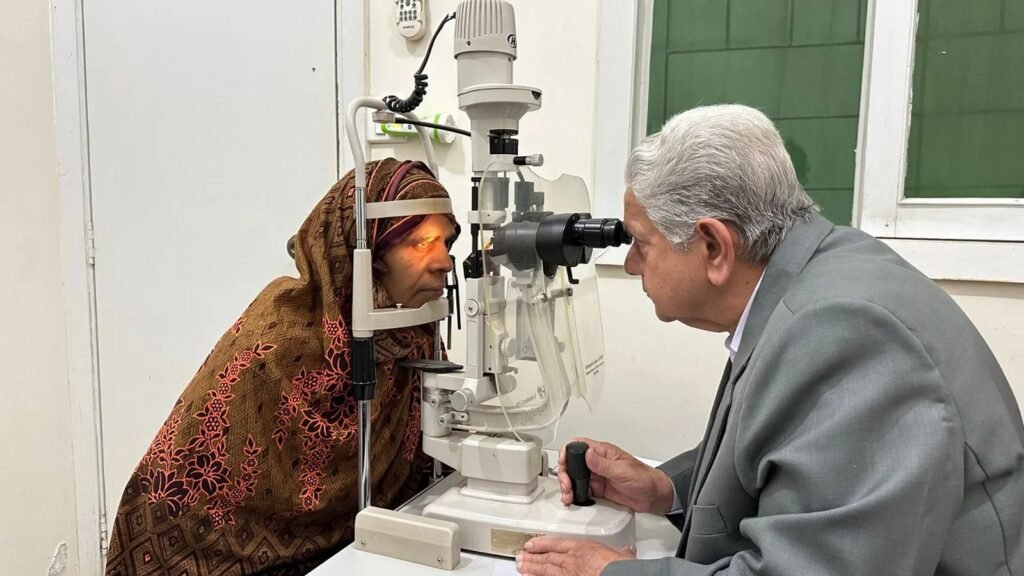
Vision problems after stroke can make ordinary tasks feel unfamiliar. Words may seem to disappear while reading, one side of a room may be harder to notice, or two images may appear instead of one. These experiences can affect confidence as well as sight. This guide explains the kinds of changes that may occur after a stroke, how an assessment can help and what to discuss with the people supporting recovery.
Why sight can change
Seeing depends on more than the eyes. The eyes gather visual information, and different parts of the brain help process and make sense of it. A stroke can affect a visual pathway or an area of the brain involved in interpreting what the eyes see. The result may be a change in the field of vision, eye movement or visual processing.
Symptoms differ from person to person. One person may have a missing area in the visual field. Another may have blur, double vision, moving images or trouble reading. Some people have difficulty recognising an object or judging how far away it is. These experiences are real, even when a standard eye chart seems easier than a busy room or a page of print. The RNIB guide to stroke-related eye conditions describes several of these changes and the kinds of support that may be considered.
Changes in the visual field
The visual field is the whole area you can see while looking in one direction, including the sides beyond the point you are focusing on. After a stroke, part of this field can be missing. Hemianopia is loss of one half of the visual field. It can affect the same side of the view in both eyes, and may make it harder to find a person or object on that side.
This can affect daily movement. A person may miss an item on a table, misjudge a kerb or feel disoriented in a crowded shop. Reading can also be tiring when words seem to vanish at the edge of the affected field. A missing area is not always obvious to the person experiencing it, so family observations can be useful when shared respectfully with the care team.
Some people are taught scanning techniques. These involve deliberately moving the eyes or head towards the side that is harder to notice. A line guide, a marker at the end of a paragraph or larger print may make reading easier. The right approach depends on the assessment. A person should ask an orthoptist or rehabilitation professional before beginning a training routine, especially if symptoms are changing.
When the two eyes do not move together
A stroke can affect the nerves or muscles that help the eyes move as a pair. This may make it hard to hold a steady focus, follow a moving object or shift from one object to another. Some people experience double vision. Others find that images seem to move or that the eyes do not travel in a particular direction as expected.
An orthoptist or eye specialist can assess the pattern and discuss possible options. Depending on the findings, support may include a prism, a temporary way of covering part of a lens or another visual aid. These are not do-it-yourself fixes. A prism that helps one person may not suit another, and the best option can change as recovery progresses.
Visual processing and attention
Not every difficulty is caused by a blurred or missing picture. After a stroke, the brain may have trouble interpreting what is seen. A person may overlook objects to one side, have trouble judging depth or movement, or find it harder to recognise familiar objects or people. The person may be able to see the page but struggle to understand the information on it.
These changes can be frustrating for the person and confusing for family members. They are not laziness or lack of effort. Describe the difficulty in specific terms to the stroke team. For example, say whether it happens at the table, while reading, in a corridor or when moving through traffic. Practical examples can help the team decide which assessment or referral is suitable.
Who can assess the problem
Vision assessment can be part of stroke rehabilitation. An orthoptist, ophthalmologist, optometrist or low-vision specialist may be involved, depending on the problem and local services. The stroke team or a doctor can advise which professional to see. A general eye examination may identify an eye condition, while a focused assessment may explore fields of vision, eye movement or visual processing.
At the visit, explain when the problem began, whether it is changing and which tasks are difficult. Bring a list of medicines and any glasses used. If someone accompanies you, ask them to describe what they have noticed without answering every question for you. You remain the best person to explain how the change feels.
Our guide to what a dilated eye examination checks explains one part of a general eye visit. The stroke team can tell you whether that kind of examination is right for your situation or whether a different assessment is needed.
Rehabilitation and practical support
Support depends on the type of difficulty. It may include visual training, glasses, a prism, magnification or changes to the way a task is arranged. Rehabilitation professionals can also discuss ways to make a room easier to scan. Put frequently used items in a consistent place and reduce clutter where it blocks a clear path. A family member can offer an arm or describe an obstacle, while allowing the person to choose how much help they want.
Reading may be easier with larger print, more space between lines or a plain marker under the line being read. Some people use an electronic device to enlarge text or change contrast. A clinician or low-vision specialist can help find a method that fits the person rather than asking them to adapt to a tool that does not work.
For walking, pause at doorways and steps until the new visual pattern feels familiar. Keep handrails clear. When outside, choose a companion or route that feels safe while the rehabilitation team assesses the change. These practical steps do not repair a visual field, but they may reduce avoidable bumps and uncertainty.
What can improve and what may remain
Some people notice improvement over the months after a stroke. The amount and timing vary. They depend on where the brain was affected, the extent of the injury, the type of stroke and other health factors. For some people, a visual field loss remains. An assessment can help distinguish what is changing from what needs longer-term support.
Exercises or computer programmes may help some people make better use of the vision that remains. They do not restore a missing visual field. Ask the clinician what a programme is meant to improve, how progress will be checked and whether it is safe for your current stage of recovery. Be cautious about anything promising to bring sight back quickly.
Keeping appointments and sharing changes
Keep the follow-up visits arranged by your stroke or eye-care team. Mention a new or worsening change rather than waiting until the next routine visit. If you are unsure whether a symptom needs earlier attention, contact the team responsible for your care and describe exactly what has changed.
A short symptom note can help. Write down the date, task and visual difficulty. Avoid trying to diagnose the cause. A simple record such as “missed the cup on the left while setting the table” is more useful than a label copied from a search result.
Questions to take to the care team
- Which part of my vision or visual processing seems to be affected?
- Which professional should assess this change?
- What should I do if the symptom changes before my next appointment?
- Would a visual aid or a change at home help with a task I find difficult?
- How will we review whether the support is helping?
Write down the answers and the name of the person to contact. If the explanation is too technical, ask for it in simpler words. A family member can help remember details, but the plan should be clear to the person receiving care.
Where to turn
For general information about arranging an eye examination, visit the PEBS Hospital contact page. It does not confirm which assessment or rehabilitation service is right for an individual. If you would like to support eye care, see the donate page. For symptoms after a stroke, follow the advice of your stroke and eye-care team.
Have a question about your eyes?
PEBS Hospital in North Karachi can examine you and explain your options. Call the helpline on 021-36908053, or send a message and the team will reply.
This article is general information and does not replace an examination by an eye doctor.