
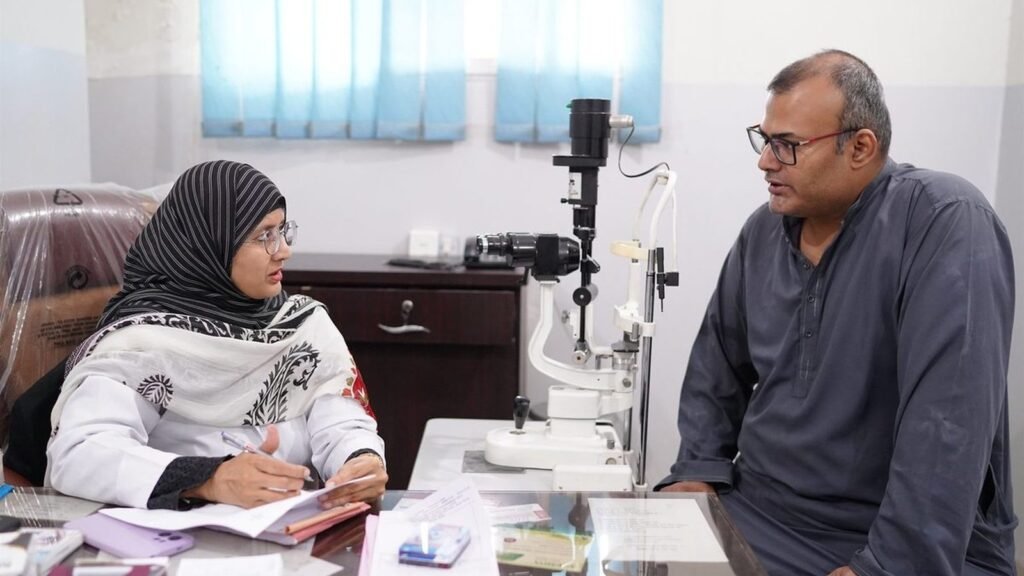
A routine eye test can end with a sentence that sounds worse than it is: your eye pressure is a little high. The medical name for this is ocular hypertension, and it is not the same thing as glaucoma. It means the pressure inside the eye has risen above the usual range while the optic nerve still looks healthy. This guide explains what ocular hypertension is, who is more likely to have it, how doctors test for it and what usually happens next. It draws on the patient information published by the American Academy of Ophthalmology.
What eye pressure is, and why it matters
A clear fluid called aqueous humor flows inside the front part of the eye. The eye makes this fluid all the time, and the same amount drains away again. That steady flow in and out keeps the pressure inside the eye constant. Doctors call it intraocular pressure, or IOP.
Trouble starts when the drainage slows down. Fluid is still made, but it does not leave properly, so the pressure builds. When it climbs above the normal range, that is ocular hypertension.
The reason doctors care about pressure is the optic nerve. This is the cable that carries what the eye sees to the brain. If high pressure damages it, the result is glaucoma, which causes vision loss.
High pressure is not the same as glaucoma
This is the point that people most often miss. In the Academy’s guide to ocular hypertension, the difference is stated plainly. With ocular hypertension, the optic nerve looks normal and there are no signs of vision loss. With glaucoma, the nerve has been harmed.
That does not make the diagnosis harmless. People with ocular hypertension have an increased risk of developing glaucoma, and doctors often call them glaucoma suspects. The word suspect sounds alarming, but it only means that the eye needs watching. No vision loss has shown up so far.
Why the watching matters is explained on the Academy’s page about glaucoma itself. Glaucoma damage is permanent and cannot be reversed. Medicine and surgery can help to reduce further damage, but they cannot give back what has gone. The whole purpose of following ocular hypertension carefully is to act before that stage.
Why you usually feel nothing at all
Ocular hypertension usually has no signs or symptoms. The eye does not hurt, the vision does not blur and nothing looks different in the mirror. A person can have high eye pressure for a long time and never know.
The same is true of glaucoma in its early years. The Academy says that half of the people with glaucoma do not know they have it. This is why it is called the silent thief of sight, and it is why waiting for a symptom is the wrong plan. The condition is found by testing, not by noticing.
If you have ever put off an eye test because your sight seemed fine, this is the reason to book one. Good vision on a chart does not rule out a pressure problem.
Who is more likely to have high eye pressure
Anyone can develop ocular hypertension. Some people have a higher chance, and the Academy lists these groups.
- Family history. A parent, brother or sister with ocular hypertension or glaucoma raises the chance.
- Diabetes or high blood pressure. Both are on the list.
- Age over 40. The list names everyone over that age.
- Strong short sight. People who are very myopic have a higher chance.
- Long-term steroid medicines. Steroid use over a long period is a known risk.
- Past eye injury or eye surgery. Either one can play a part.
- Certain eye conditions. Pigment dispersion syndrome and pseudoexfoliation syndrome are named.
If one or more of these applies to you, say so at the start of your next eye visit. These are facts that a doctor cannot see through a microscope. They only come out when someone asks, or when the patient volunteers them.
How doctors measure it
The test is quick. Your eye is numbed with drops, and the doctor uses an instrument called a tonometer. It measures how much your cornea resists a slight pressure, and from that the doctor works out the pressure inside the eye.
The doctor may also measure the thickness of your cornea with a pachymeter. This is a simple and fast test. It helps the doctor understand your personal risk of glaucoma.
Then comes the part that matters most. The doctor checks for glaucoma itself by examining the optic nerve for signs of damage and by testing your side vision. A single pressure number is never the full story. The Academy is clear that a screening which checks only eye pressure is not enough, and that the only sure way to diagnose glaucoma is a complete eye exam. A separate guide on what a dilated eye exam checks describes what a complete exam looks like from the patient’s chair.
What happens after the diagnosis
The next step depends on how high the pressure is and on the rest of your eye health. The Academy describes three broad paths.
- Watching. If the pressure is only slightly raised, the doctor may decide not to start treatment right away. You are tested regularly instead, so that any change can be spotted over time.
- Eye drops. If the doctor decides that treatment is needed, the Academy says eye drops may be prescribed. A follow-up visit is arranged within several weeks to see how the medicine is working. Sometimes more than one medicine is prescribed.
- Laser or surgery. These are sometimes used to lower eye pressure.
The Academy adds an honest point. Treatment lowers the risk of glaucoma, but it does not remove the risk. Some people with ocular hypertension still go on to develop glaucoma. If that happens, the doctor will talk through the treatment options for it. This is another reason the follow-up visits are not optional.
Using eye drops properly
Drops only work when they are used exactly as directed. The Academy stresses this for ocular hypertension, and its glaucoma guide says never to change or stop glaucoma medicines without talking to your ophthalmologist. If you are close to running out, ask whether the prescription should be refilled before the bottle is empty.
A few habits make the routine easier.
- Tie the drops to something you already do at the same time every day, such as a meal.
- Keep the bottle where you will see it, and keep a note of the dates you have used it.
- Give your doctor a list of every medicine you take regularly, because some drugs cause problems when taken together.
- Report any side effects. The Academy lists stinging, itching, red eyes and blurred vision among the possible ones.
The practical details of getting a drop into the eye without waste or contamination are covered in a guide to putting in eye drops safely.
When high pressure becomes an emergency
Everything above describes pressure that rises slowly and silently. There is a different situation in which it rises fast. This happens in a form of glaucoma called angle-closure glaucoma, when the drainage channel of the eye is suddenly blocked. The Academy calls an attack of this kind a true eye emergency.
The signs of an attack are these.
- Sudden blurred vision.
- Severe pain in the eye or forehead.
- A headache.
- Nausea or vomiting.
- Rainbow-coloured rings or halos around lights.
- A red eye.
Anyone with these signs should contact an eye doctor right away. Do not wait for the morning, and do not wait to see whether it settles. The Academy warns that without prompt treatment a person with angle-closure glaucoma can go blind. More about glaucoma in general is available in a guide on why glaucoma is a sight loss you do not feel.
Questions worth asking at your visit
People often leave an eye clinic with a diagnosis and no clear idea of what it means for them. Writing questions down before the visit helps. A family member who comes along can write the answers.
- What is the pressure in each of my eyes today?
- Does my optic nerve look healthy, and has anything changed since the last visit?
- Do I need a side vision test, and how often?
- How soon should I come back, and what should I do if something changes before then?
- Does any medicine I take, including steroid tablets, creams or drops, affect eye pressure?
- Should my brothers, sisters or children have their eyes tested too?
The last question is worth asking even if you feel well. A family history of glaucoma raises the chance for relatives, and relatives are rarely told unless someone speaks up.
Where to start
If you have been told that your eye pressure is high, or glaucoma runs in your family, a full eye examination is the right next step. For questions about ocular hypertension, ask PEBS about high eye pressure. Anyone who wants to give can use the hospital’s published donation methods.
High pressure is a number that a doctor can follow, and following it is what keeps a warning from turning into a loss.
Have a question about your eyes?
PEBS Hospital in North Karachi can examine you and explain your options. Call the helpline on 021-36908053, or send a message and the team will reply.
This article is general information and does not replace an examination by an eye doctor.