
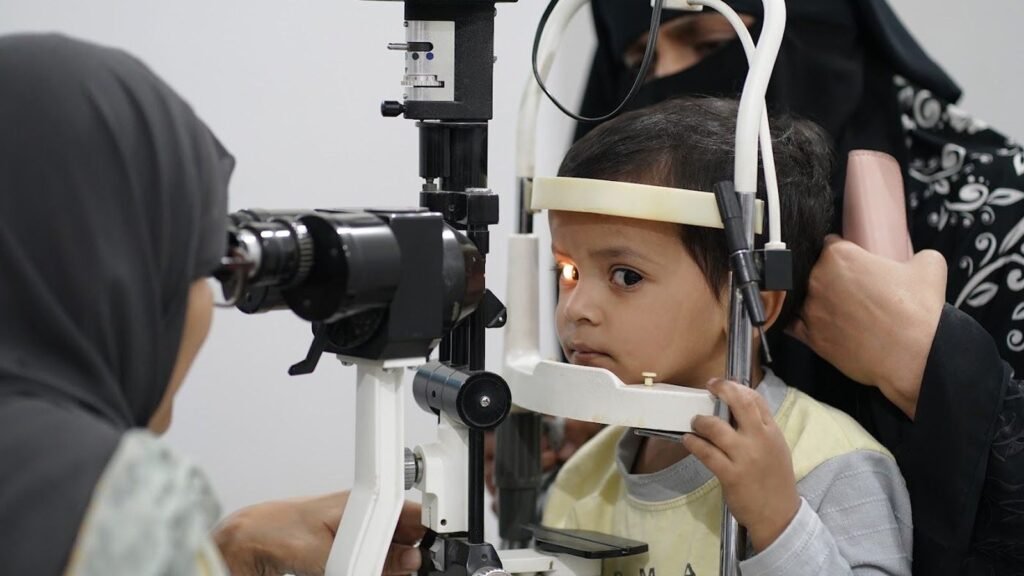
A keyhole pupil, a pupil that runs down into a notch instead of being round, is most often caused by coloboma, although eye surgery or an injury can also change the shape of the pupil. Coloboma means that part of the eye did not form completely before birth. The keyhole shape is the visible clue when the iris is involved. In other cases, the affected tissue is at the back of the eye and cannot be seen from outside. How much sight is affected depends on the structures involved, the size of the gap and whether one or both eyes are affected.
The first question is where it is
An eye develops through several stages during pregnancy. Part of this development involves tissue joining together. If that joining is incomplete, a gap can remain in one or more structures.
Coloboma is present from birth and continues into adulthood. It is not simply a mark that appears later. Its effect cannot be judged from the name alone.
Ask the ophthalmologist to show you which part of the eye is involved, using a drawing if helpful. Knowing the location makes later explanations about vision and follow-up easier to understand. The medical background in this guide comes from RNIB’s patient information.
When the iris is involved
The iris is the coloured part around the pupil. A gap in the iris can make the pupil look oval or keyhole-shaped. Someone whose coloboma affects only the iris may still have good vision.
Light sensitivity can nevertheless be a problem. More light can enter through the gap, producing glare or discomfort in bright conditions. The visible shape and the effect of glare are related, but they are not a full measure of sight.
Tell the clinician what happens in different lighting. Ask whether the problem is light sensitivity, a separate focusing error or another finding. Treatment should address the actual difficulty rather than only the appearance.
When the lens support is affected
The ciliary body is behind the iris. Structures attached to it help support the natural lens. If this support is uneven because tissue is underdeveloped, the lens may develop a notch or altered shape.
That change can interfere with focusing and cause blur. Cataract, or clouding of the lens, may also be present. This is a different situation from an isolated iris gap.
Ask whether the lens is clear and properly supported. If glasses are recommended, ask which part of the blur they are intended to correct. A detailed explanation helps avoid expecting one treatment to solve several different problems.
When the back of the eye is involved
The retina and the choroid line the back of the eye. The choroid contains blood vessels that support the retina. Coloboma involving these tissues is called chorioretinal coloboma.
The effect on sight varies. Some people notice little difficulty, while a larger affected area can have more impact. The upper part of the visual field can be affected. Central vision may be poorer when the area is large.
Coloboma can also affect the optic disc, where the optic nerve leaves the eye. Our explanation of a dilated eye examination describes why examining the back of the eye is different from judging its appearance.
Why early predictions may be uncertain
A very young child cannot describe how clearly they see. It can take time to understand the full effect of a congenital eye condition. Regular appointments allow the team to assess vision as the child develops.
Ask what is known now and what cannot yet be measured reliably. Uncertainty does not mean there is no useful care to provide. Correcting an additional focusing problem and supporting development can still matter.
Try to keep the description specific. The same diagnosis can affect two children differently. A story from another family may provide support, but it cannot predict your child’s visual result.
Glasses treat a separate focusing problem
Short sight, long sight or astigmatism may be present alongside coloboma. Glasses or contact lenses can correct these focusing errors. They cannot replace tissue that did not develop.
For a child, correcting the focusing error helps make the available image as clear as possible. Continued visual difficulty does not necessarily mean the glasses are useless. They may be correcting one part of a more complex problem.
Ask the optometrist what improvement the prescription can reasonably provide. Report problems with wearing the correction. A child who cannot use the prescribed glasses comfortably needs practical help with that difficulty.
When patching is considered
If one eye sees less well, the brain may favour the stronger eye. Amblyopia can develop in the weaker eye. In some children, the team may recommend covering the stronger eye for prescribed periods.
Patching aims to support the use and development of the weaker eye. It does not close the coloboma. The expected benefit depends on the child’s findings.
Follow the individual schedule and ask for help if it is hard to manage. Do not start patching on your own or extend the hours because another child has a different plan. Ask which eye is to be covered and for how long.
Options for troublesome light sensitivity
Many iris colobomas need no treatment. For selected people, a specially designed contact lens can make the pupil opening effectively rounder. This may reduce light sensitivity and change the appearance.
Surgery to close an iris gap is another option in some circumstances. It is not suitable or necessary for everyone. Ask the specialist what problem the procedure would address and what risks apply.
Practical changes to lighting can also be discussed. The aim is to make tasks comfortable without assuming that brighter lighting always helps. Glare and inadequate light are different difficulties, and the preferred arrangement can vary.
Why checks continue as a person grows
Some associated eye problems may need monitoring. These can include cataract, glaucoma, retinal detachment and abnormal blood vessel growth. A squint or amblyopia may also be relevant.
This does not mean every person develops all of these conditions. It means the eye team should decide the appropriate review plan. Adults with coloboma also need continuing eye checks.
Report new symptoms or concerns promptly between appointments. Do not assume that a new change is simply the same congenital condition. Ask the team which warning signs require urgent assessment in your particular case.
Helping at school and at home
Support should match the measured vision and the activities that are difficult. Larger or bolder print, stronger contrast and reduced glare can be useful. A low vision assessment can explore aids for tasks that remain difficult with ordinary correction.
Ask a teacher what the child finds hard to see. The issue may involve print, material at a distance or the position of a task. Our guide to classroom signs of visual difficulty can help frame that conversation.
Share the child’s actual needs, rather than only the diagnosis name. If specialist educational support is needed, ask what is available locally. Services described in British guidance should not be assumed to have the same structure in Karachi.
Making room for questions about the future
Families may worry about education, work and independence before those questions can be answered. Bring those concerns to the clinic. Ask which support can be arranged now and which decisions will depend on later assessments.
It is reasonable to ask the team to repeat an explanation or write it down. A diagnosis often arrives with unfamiliar terms. Understanding the affected structures and the next appointment is a useful starting point.
If different relatives attend appointments, keep a shared record of the current advice. Write down what was found, what was recommended and who to contact. This avoids relying on several different recollections when a new question arises.
For the medical source, see RNIB’s information about coloboma. To ask about your case, use the PEBS enquiry page for coloboma. Those wishing to give can visit the donate page.
A pupil’s shape is only one part of the story; the examination and the person’s daily experience should guide the plan.
Have a question about your eyes?
PEBS Hospital in North Karachi can examine you and explain your options. Call the helpline on 021-36908053, or send a message and the team will reply.
This article is general information and does not replace an examination by an eye doctor.
