
Most people go to an eye doctor for a reason. The print has become small, a child is squinting at the board, or something hurts. Far fewer go while everything seems fine. Yet some serious eye diseases give no warning in their early years. So the useful question is not only what to do when something is wrong. It is how often to have an eye exam when nothing is. This guide sets out the schedule that the American Academy of Ophthalmology recommends, who needs checks more often, and what a full exam includes.
One schedule does not fit everyone
The Academy’s guide to eye exams and vision testing divides people into groups by age and by risk. Treat it as a starting point. After any exam, your own doctor can tell you how often your eyes should be checked, and the Academy says it is important to follow that schedule, especially as you grow older. Your risk of eye disease goes up with age.
The groups below are the ones the Academy describes. Find the one that fits you and the people in your family.
Children, from birth to the teenage years
A child’s eyes grow and change quickly, from the first weeks of life through the teenage years. Because of this, the Academy and the American Association for Pediatric Ophthalmology and Strabismus have written specific screening guidelines for children. The aim is to check a child at the right times and to spot when a full eye exam is needed.
A parent does not need to memorise a timetable. What matters is that the child is looked at regularly, and that nobody waits for a problem to announce itself. A guide to the signs a child cannot see the blackboard lists the habits that should prompt a check sooner.
Healthy adults under 40
If your eyes are healthy and your vision is good, the Academy says you should have a complete eye exam every 5 to 10 years while you are under 40. This is the age range when early signs of disease or changes in vision may first appear. The point of the exam is to find problems early, because early treatment can help to preserve your sight.
Notice what this schedule assumes. It is for people with no eye disease, no risk factors and no symptoms. It is a baseline, not a limit. It does not mean that nothing needs attention in the years between.
Adults who should not wait
Some adults should not wait until they are 40. The Academy says to see an ophthalmologist now if you already have an eye disease or if you have risk factors such as these.
- Diabetes. Diabetes can affect the retina, and a separate guide explains why a yearly retina check matters.
- High blood pressure. It is on the Academy’s list of risk factors.
- A family history of eye disease. If a parent or sibling has had glaucoma, for example, your own risk is higher.
After your exam, the doctor will tell you how often to come back. Write that interval down. It is the most useful piece of information you will take home.
Problems that cannot wait for a schedule
No timetable applies when something changes suddenly. The Academy says to call your ophthalmologist if you have an eye infection, an injury or eye pain. It says the same if you notice sudden floaters and flashes, or patterns of light. These are reasons to be seen promptly, not at the next routine date.
Contact lens wearers
People who wear contact lenses have their own rule. The Academy says to see an eye specialist every year. A yearly visit is a chance to check the prescription and the health of the eye.
From 65 onwards
If you are 65 or older, make sure your eyes are checked every year or two. At this age, the doctor is looking for age-related eye diseases. The Academy names four.
- Cataracts.
- Diabetic retinopathy.
- Age-related macular degeneration.
- Glaucoma.
Glaucoma deserves a special mention, because it can reduce side vision slowly without the person noticing. A guide to the sight loss you do not feel explains why regular testing is the only dependable defence.
Putting it together for one household
Here is how the Academy’s groups might look inside a single family. The example is made up to show the pattern. It is not a real case.
- A young child follows the childhood screening guidelines, and the doctor says when a full exam is needed.
- A parent in their thirties, with healthy eyes and no risk factors, is in the baseline group, with a complete exam every 5 to 10 years.
- An uncle with diabetes should not wait for the baseline age. His doctor sets how often he is seen, and the Academy says to follow that schedule.
- A grandmother of 70 is in the older group, with a check every year or two.
Four people, four different answers. This is why a single rule such as every two years does not work for a whole household.
A quick check is not the same as a full exam
People sometimes count a school vision check or a glasses test as their eye exam. The Academy draws a line between screening and a complete exam. Childhood screening is meant to show when a child might need a complete exam. In its guide to glaucoma, the Academy also says that a screening which checks only eye pressure is not enough, because the only sure way to diagnose glaucoma is a complete eye exam.
Checking the prescription for glasses is only one part of the complete exam described below. The other parts look at the health of the eye.
What a complete eye exam includes
The Academy describes a complete exam as simple and comfortable, and says it should not take more than 45 to 90 minutes. Some parts may be done by a member of staff rather than the doctor. Here is what it should cover.
- Your history. The doctor asks about your vision and general health, your family’s medical history, the medicines you take and whether you wear glasses or lenses.
- Visual acuity. You read a chart with one eye covered at a time. This shows whether you reach the standard written as 20/20 in the United States and 6/6 in many other countries.
- Your prescription. You look through a device holding different lenses, which helps to find the best glasses or contact lens prescription.
- Your pupils. A beam of light shows how the pupils respond. They normally get smaller. If they widen or do not respond, that may reveal an underlying problem.
- Your side vision. Loss of side vision can be a symptom of glaucoma. The test finds problems that you cannot feel, because side vision can go without being noticed.
- Your eye movement. The doctor checks that the eyes are lined up and that the eye muscles work properly.
- Your eye pressure. This may involve a quick puff of air, or a gentle touch with a pressure-sensitive tip, sometimes after numbing drops.
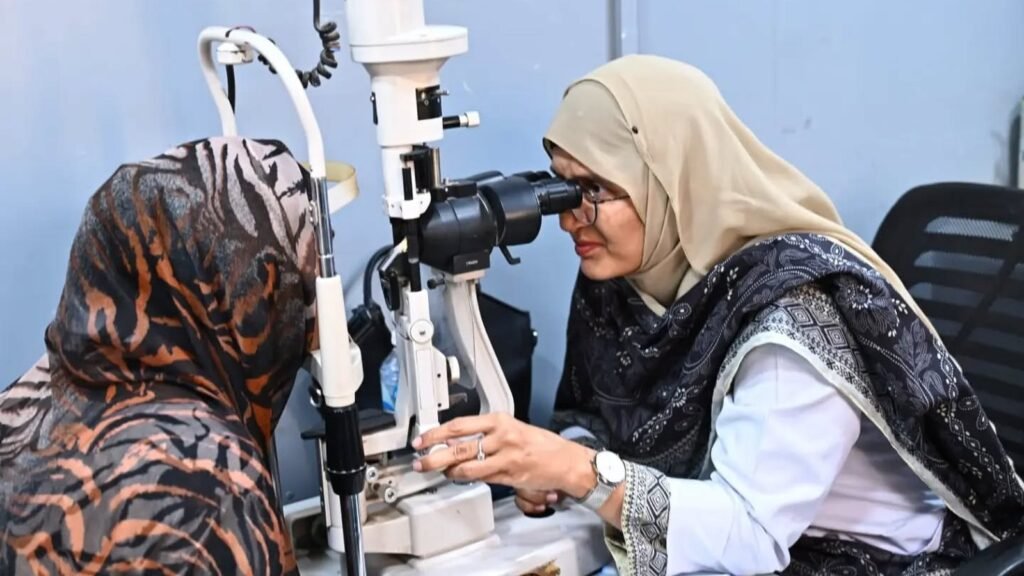
- The front of the eye. A slit-lamp microscope lights up the eyelids, cornea, iris and lens, and the doctor looks for cataracts or scars and scratches on the cornea.
- The retina and optic nerve. Dilating drops widen the pupil so the doctor can see the back of the eye. The eyes may be sensitive to light for a few hours afterwards.
The dilation step is the one that surprises people most. A separate guide explains what a dilated eye exam checks and how to prepare for it.
Extra tests you may be offered
Sometimes the doctor wants a closer look. The Academy lists several tests that may be added.
- Optical coherence tomography, a scan of the layers at the back of the eye.
- Fundus photographs, which are pictures of the inside of the eye.
- Fluorescein angiography, which follows dye through the blood vessels of the retina.
- Topography, a scan of the surface of the cornea.
- Automated visual field testing, which maps what you can see at the sides.
These tests help the doctor find problems at the back of the eye, on its surface or inside it, so that diseases can be diagnosed early. If a test is suggested, ask the doctor what it is looking for.
How to get ready for the visit
A little preparation makes the visit more useful.
- Bring your current glasses or lenses, even if you think they are out of date.
- Bring a list of every medicine you take, or the boxes themselves.
- Find out what you can about eye disease among your parents, brothers and sisters.
- Write down any symptoms, including when they started.
- If drops will be used to widen your pupils, ask someone to come with you, and bring sunglasses.
Put the date of your next exam somewhere you will see it, such as a phone reminder or the family calendar.
Booking the visit
If you cannot remember when your eyes were last checked, or if the answer is never, that is reason enough to book one. For questions about an eye examination for yourself or your child, ask PEBS about eye examinations. To give, review the hospital’s donation methods.
The best eye exam is the one that happens before there is anything to complain about.
Have a question about your eyes?
PEBS Hospital in North Karachi can examine you and explain your options. Call the helpline on 021-36908053, or send a message and the team will reply.
This article is general information and does not replace an examination by an eye doctor.
