
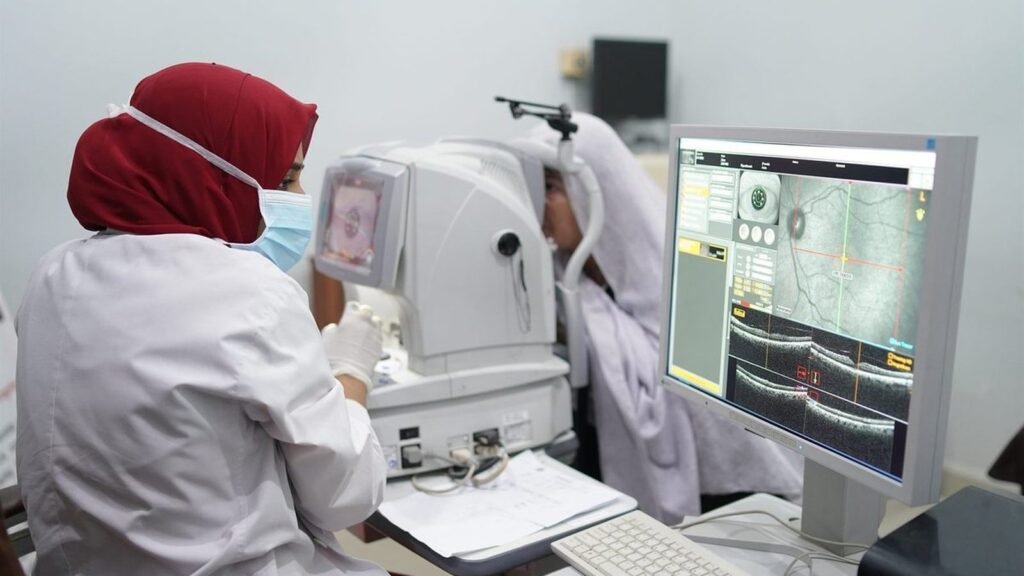
If you live with diabetes, the appointment that protects your sight is not the one you make when your vision goes blurry. It is the one you make while everything still looks fine. That is the difficult truth about diabetic retinopathy in Pakistan and everywhere else, and it is the reason an eye check for a person with diabetes is booked by the calendar rather than by symptoms.
Why diabetes reaches the eyes at all
Diabetes is a condition of the blood, not of the eye, but the eye is one of the places where the damage shows up first. The World Health Organization’s fact sheet on diabetes explains that raised blood glucose over time causes serious damage to the body’s systems, especially the nerves and blood vessels, and it names blindness among the consequences of diabetes alongside kidney failure, heart attack, stroke and lower limb amputation.
The same WHO fact sheet records how much larger this has become. It states that the number of people living with diabetes rose from 200 million in 1990 to 830 million in 2022, and that prevalence has been rising more rapidly in low and middle income countries than in high income ones. It also notes that in 2022, more than half of adults aged 30 and over who were living with diabetes were not taking medication for it, with treatment coverage lowest in low and middle income countries.
We have not quoted a Pakistan specific figure here, and that is deliberate. The WHO fact sheet is global. We would rather give you a number we can stand behind than a local one we cannot.
The part that catches people out
The United States National Eye Institute, in its guidance on diabetic retinopathy, describes it as an eye condition that can cause vision loss and blindness in people who have diabetes, affecting the blood vessels in the retina, the light sensitive layer of tissue at the back of the eye. The point it makes most firmly is the one people find hardest to accept. The early stages usually have no symptoms at all.
Read that again if you have diabetes. No pain. No redness. No blurring. Nothing that would send you to a doctor. The National Eye Institute states that anyone with any kind of diabetes can develop it, including type 1, type 2 and gestational diabetes, and that the risk increases the longer a person has diabetes.
Later, when the disease has advanced, it can announce itself. The National Eye Institute describes dark floating spots or streaks that look like cobwebs, caused by bleeding into the gel that fills the eye. By then you are no longer catching something early. You are responding to something that has already happened.
Why the check is yearly
Because there is nothing to feel, the check cannot be triggered by feeling. The National Eye Institute’s guidance is that a person with diabetes should have a comprehensive dilated eye exam at least once a year, and it adds that women with diabetes who become pregnant, or who develop diabetes during pregnancy, are at high risk and should have that examination as soon as possible.
The World Health Organization fact sheet makes the same point from the other direction. Among the additional medical care that people with diabetes may need, it lists eye examinations to screen for retinopathy.
There is a second reason not to skip the year. The National Eye Institute notes that having diabetes also makes cataracts more likely and at a younger age, and that it roughly doubles the risk of open angle glaucoma. One appointment looks at all of it.
What is worth knowing about treatment, and what is not
We will not describe a treatment plan on a web page, because a treatment plan belongs to a doctor who has examined your eyes. But one piece of general information is worth carrying with you, because it changes how urgently people act.
The National Eye Institute states that treatment can stop vision from getting worse, while noting that it will not undo damage that has already been done. That is the whole argument for the yearly appointment in one sentence. Sight that is protected early stays. Sight already lost is a different conversation.
Nothing here is a promise about any individual outcome, and nothing here is advice about medicine. Take both to your own doctor.
Where PEBS fits
PEBS Hospital is not only an eye hospital, and for a patient with diabetes that turns out to be useful. Our hospital services page describes a Cardiac and Diabetes Unit, established in 2018 and led by cardiologists, physicians and diabetologists, whose listed preventive services include diabetes screening, blood pressure screening, cholesterol screening, and guidance on lifestyle, nutrition and physical activity. Its listed diagnostic facilities include electrocardiography, echocardiography, exercise stress testing, blood pressure monitoring, cholesterol assessment and diabetes screening. Our home page describes the same unit as running cardiac echo and HbA1c laboratory work for early intervention.
The same page describes the Eye Unit, established in 1993, and lists the diagnostic services it offers, including slit lamp evaluation, auto refraction testing, perimetry, puff tonometry, A and B scans, and optical coherence tomography. Dr Kashif Farooqui is named there as Head of Department.
What that means in practice is that the blood side and the eye side of your diabetes can be looked at in one building. What it does not mean is that you should decide for yourself which tests you need. Ring the OPD, say that you have diabetes and that you want your eyes checked, and let the doctor decide what the examination should include.
If you cannot get to Karachi
Distance is a real barrier and we do not pretend otherwise. Our Gift of Life medical camps travel to remote and underserved areas to screen, treat and operate free of cost, and PEBS states that complex cases found at a camp are referred on to PEBS Hospital in Karachi for free specialist care. PEBS also states that its Gift of Vision programme has provided free cardiac and diabetes checkups alongside cataract surgery in camps across Sindh, Balochistan and Punjab.
Camp dates and locations change, so please do not plan a journey on the strength of an article. Call and ask where the next camp will be before you travel.
What you can do between appointments
The World Health Organization fact sheet lists reaching and keeping a healthy body weight, staying physically active with at least 150 minutes of moderate exercise each week, eating a healthy diet while avoiding sugar and saturated fat, and not smoking tobacco. None of that is new advice and all of it is hard to keep up. It is still the advice.
Keep your own records too. Note the date of your last eye examination somewhere you will see it, the way you would note a vehicle’s fitness certificate. Diabetic retinopathy in Pakistan is missed far more often through a forgotten year than through a wrong decision.
When not to wait for the yearly slot
One group of symptoms is not a reason to book sooner. It is a reason to be treated now. The National Eye Institute, on the diabetic retinopathy guidance quoted throughout this article, states that in the later stages of the disease the blood vessels in the retina start to bleed into the gel that fills the eye, that if this happens you may see dark floating spots or streaks that look like cobwebs, and that sometimes the spots clear up on their own but it is important to get treatment right away. It adds that without treatment scars can form at the back of the eye, and that the bleeding may start again or get worse.
So if you see dark floating spots or streaks, do not wait for the annual appointment and do not wait to see whether they clear. Get to an eye doctor the same day. If that falls outside hospital hours, go to the nearest hospital with an emergency department rather than waiting for the OPD to open.
A sudden change in how clearly you see, or vision that comes and goes, is also a reason to be examined now rather than at the next yearly slot. Diabetic retinopathy in Pakistan is rarely missed because a family made a bad decision. It is missed because nothing hurt, and the year went by.
Support for this work comes from donors, and free and subsidised care at PEBS is funded that way. If you would like to help another family get the check you have just read about, our donate page explains how. If you simply want to ask a question about coming in yourself, our contact page has the details.
Whatever your numbers have been doing lately, the eyes are not the place to find out late. Speak to an eye specialist about your own eyes, and book an appointment on 021-36908053.
Have a question about your eyes?
PEBS Hospital in North Karachi can examine you and explain your options. Call the helpline on 021-36908053, or send a message and the team will reply.
This article is general information and does not replace an examination by an eye doctor.
