
Among all the causes of blindness in the world, one stands out for how ordinary its remedy is. A child can lose their sight permanently because of a shortage of a single vitamin, and the deficiency that causes it can be corrected with food, or with a supplement costing very little. It is one of the few forms of blindness where the intervention is not surgical, not technical, and not expensive. It simply has to reach the child in time.
What vitamin A does for the eye
Vitamin A is needed for the eye’s surface to stay moist and intact, and for the retina to work in dim light. When it runs short, two things begin to happen. Night vision fails first, because the retina cannot make enough of the pigment it needs. Then the surface of the eye starts to dry, and a dry cornea is vulnerable in a way a healthy one is not.
The sequence that ends in blindness
The progression has a recognised order. Night blindness comes first and is reversible. The whites of the eyes then become dry and dull, and small foamy patches may appear on the surface, which is also reversible. If the deficiency continues, the cornea itself begins to soften and can ulcerate. At that stage damage becomes permanent very quickly, and a child who was treatable weeks earlier is not.
Why it moves so fast at the end
This is the part that surprises people. The early stages can persist for a long time without anyone noticing, and then the final stage can take hold in days. A child who seemed only mildly unwell can lose both eyes in the course of a short illness. It is the abruptness of that last step, after a long and quiet build-up, that makes the condition so dangerous.
Who is most at risk
The World Health Organization identifies young children and pregnant women as the groups most affected, and describes vitamin A deficiency as a significant public health problem in many countries. Risk concentrates where diets are limited, where young children are not getting enough of the foods that supply it, and where repeated illness is depleting whatever they do get.
Why illness makes it worse
Deficiency and infection feed each other. A child with a poor vitamin A status is more vulnerable to infection, and infection in turn burns through their remaining stores and reduces what they absorb. Measles and diarrhoeal illness are particularly associated with pushing a marginal child over into a critical deficiency. This is why an eye problem can appear during or shortly after an unrelated illness, seemingly out of nowhere.
The signs a parent can actually notice
The most useful early sign is behavioural rather than visible. A child who could see normally in dim light and now cannot, who becomes hesitant or clingy at dusk, who stops moving confidently around the house once the lights are low, is worth having checked. It is easy to read as fear of the dark or ordinary clinginess. Dryness or a dull, wrinkled appearance to the whites of the eyes is the next stage and is a reason to seek help promptly rather than watch.
Why the eye is often the first place it shows
Vitamin A matters for immunity and growth as well as vision, but the eye is where deficiency tends to declare itself visibly and early. That makes eye signs useful as a warning about the child’s wider nutritional state, not only about their sight. A child with these eye changes usually has a broader problem that the eyes happened to reveal first.
What treatment looks like
Where deficiency is caught before the cornea is damaged, correcting it is straightforward and the eye changes reverse. Where the cornea has already ulcerated, the situation is different and the damage may be permanent even after the deficiency is corrected. The entire difference between those two outcomes is how early the child was seen, which is why detection matters more here than in almost any other eye condition.
Why this is a screening problem, not only a nutrition problem
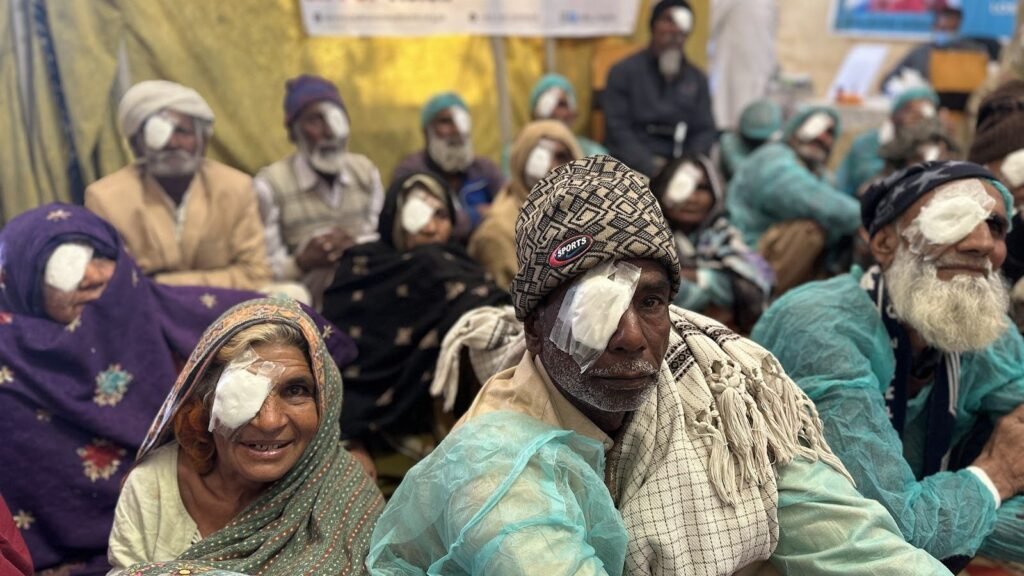
The children at highest risk are often the least likely to be brought to a clinic for something as unalarming as difficulty seeing at dusk. Families may not connect it to nutrition, or may not regard it as a medical matter at all. Finding these children generally means going to them, which is what community camps and outreach work are for. A child found at the night blindness stage keeps their sight. The same child found six weeks later may not.
What schools can and cannot catch
Organised school eye screening picks up a great deal, but the children most at risk of severe vitamin A deficiency are frequently younger than school age, and are the ones least likely to be enrolled if they are old enough. So the school route, valuable as it is for refractive error and amblyopia, is not the main answer to this particular problem. It has to be found earlier and elsewhere.
Why this belongs in a conversation about blindness
People tend to picture blindness as something that happens at the end of life, the accumulation of age. A child blinded by vitamin A deficiency is at the opposite end of that picture, facing a lifetime without sight because of a shortage that could have been corrected for the price of very little. It is among the clearest illustrations of why the phrase avoidable blindness is not an abstraction.
Where the vitamin actually comes from
It reaches the body by two routes. Preformed vitamin A comes from animal sources such as liver, eggs, milk and fish. The other route is through carotenoids in plants, which the body converts, and these come from dark green leafy vegetables and from orange and yellow produce such as carrots, sweet potato, pumpkin and mango. Diets built almost entirely on a single staple grain, with very little of either group alongside, are where deficiency concentrates. That is a question of what is affordable and available locally far more than a question of what parents know.
Why the poorest households are hit twice
The same household that cannot reliably obtain vitamin A rich food is usually also the one furthest from a clinic, least able to lose a day’s earnings to a hospital visit, and least likely to have anyone flag an eye problem early. So the deficiency and the barrier to treating it arrive together, in the same home, for the same reason. Any programme that addresses only one half of that runs into the other.
What a mother’s own status has to do with it
Vitamin A status during pregnancy and breastfeeding shapes what an infant starts life with and receives afterwards. A mother who has been deficient through pregnancy has less to pass on, and the child begins with a smaller reserve. It is one of the reasons this is treated as a family and community problem rather than an individual child’s problem, and why interventions aimed at women affect childhood blindness rates.
The scar that remains after the crisis
Where a corneal ulcer heals, it frequently heals with scarring, and scarred corneal tissue does not become clear again. A child can survive the acute episode, recover their general health completely, and still be left with a permanently clouded cornea and greatly reduced sight. At that point the condition has moved out of the reach of nutrition entirely and into the territory of corneal surgery, which depends on donated tissue and is a far longer and less certain road than the supplement that would have prevented it.
What actually changes the outcome
Three things, in order of how often they fail. Somebody has to look for the early signs, in the places where the children at risk actually are. Somebody has to recognise what they mean rather than treating night vision trouble as a quirk. And treatment has to follow immediately rather than at the next convenient appointment. Screening that reaches young children in under-served communities is the part that most often does not exist, and a donation is what puts it there.
Have a question about your eyes?
PEBS Hospital in North Karachi can examine you and explain your options. Call the helpline on 021-36908053, or send a message and the team will reply.
This article is general information and does not replace an examination by an eye doctor.
