
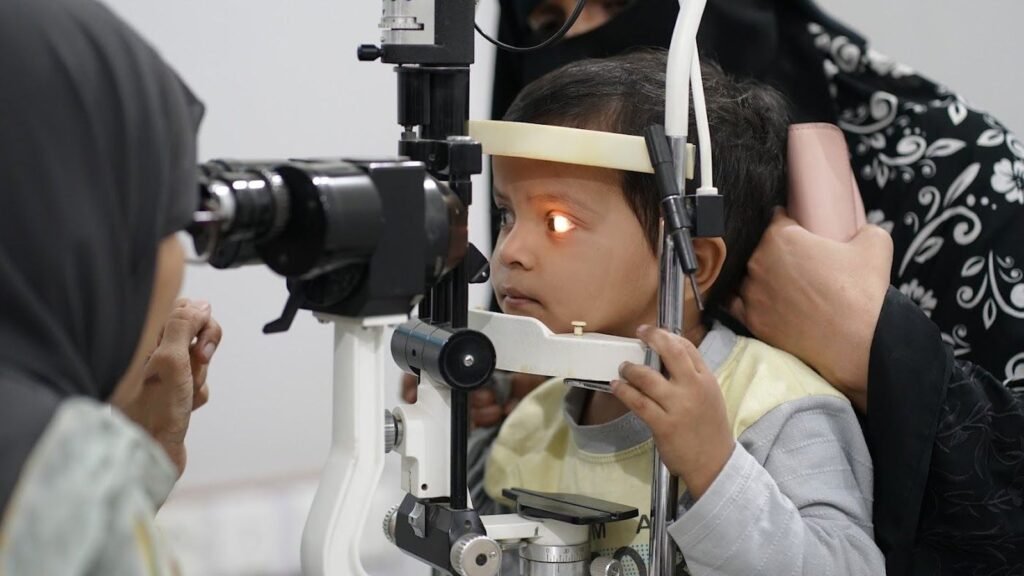
Stargardt disease is an inherited eye condition that commonly begins to affect sight in childhood. Some people first lose vision as adults. It mainly affects central vision, the part needed to see fine detail straight ahead. A young person may describe a hazy or dark area in the centre of what they see.
The Foundation Fighting Blindness explains the inherited condition and the role of genetic testing and low-vision support. This guide also suggests practical questions to take to an appointment. It is not a diagnosis for a child who finds schoolwork difficult or an adult noticing blurred sight. Those concerns need an eye examination.
The macula is the part affected most
The macula is a small area of the retina at the back of the eye. It provides sharp central vision. In Stargardt disease, fatty material builds up in this area and damages light-sensitive cells over time.
The Foundation Fighting Blindness guide to Stargardt disease describes a gradual loss of central sight in both eyes. The rate of change varies between people. A description of the usual course cannot predict exactly what will happen to one person.
Ask the eye doctor to explain which part of vision the examination has measured. Central detail and side vision are different. A person may have difficulty with one task while still managing another. Relatives should avoid using one successful activity as proof that the reported difficulty is not real.
Changes worth describing at an appointment
The difficulty a person reports deserves attention even before a diagnosis is confirmed. Ask them to describe what they can see, what they cannot see and which activities have become frustrating. Do not turn a symptom checklist into a diagnosis.
Explain the problem in the person’s own words. Ask a child what becomes hard to see instead of asking them to agree with a diagnosis. A short note about the task and the difficulty can help the clinician understand why the appointment was requested.
Teachers may notice difficulties before a child can explain them clearly. The article on signs that a child is struggling to see the board discusses observations worth taking seriously. Those signs can have several causes; they do not establish Stargardt disease.
Bring previous eye-test results if they are available. Explain when the change was first noticed and whether the difficulty has changed. If relatives have a confirmed eye diagnosis, include that information. Avoid replacing an examination with repeated comparisons to pictures of how different diseases supposedly look.
What the gene explanation means
Stargardt disease is usually associated with changes in the ABCA4 gene, although other genetic forms exist. An inheritance explanation needs to match the individual diagnosis. It should not be guessed from the age at which someone first noticed a problem.
For a family appointment, separate questions about the person already diagnosed from questions about relatives. Ask which questions can be answered now and which require a different appointment or further results. Give everyone time to understand the explanation before making decisions.
The gene name is not a reason to make assumptions about every member of a family. Ask whether genetic testing is recommended to confirm the diagnosis. Also ask whether a discussion with a genetics professional would help with questions about relatives or future children.
If a genetic report has already been issued, take the report itself to the appointment. Remembering a gene name is not the same as having the full result available. Ask the professional to explain what the result confirms and what uncertainty remains.
How examinations and scans contribute
Ask the eye doctor which examinations are needed and what each result would clarify. A scan, a sight measurement and a genetic report answer different questions. Do not assume a list of tests found online is the plan for this particular appointment.
Ask which question each test is intended to answer. Some tests examine retinal structure, while others examine function. A series of unfamiliar names can feel overwhelming until the clinician explains how each result fits the diagnosis.
Keep copies of the reports that are supplied and note the next review date. At a later visit, ask how current findings compare with earlier ones. This is more useful than interpreting a photograph or scan without the clinical explanation.
Take supplement questions to the appointment
If advice about vitamins has been confusing, prepare a short list of the products being discussed. Include products recommended by friends and anything already being taken. Ask the clinician to address the actual ingredients and the confirmed diagnosis, rather than a general promise on the packaging.
If the person already takes a supplement, bring its packaging or a clear list of ingredients to the clinician. Ask whether the product is appropriate for the confirmed diagnosis. Do not assume a product labelled for eye health is suitable for every inherited retinal condition.
This article does not give an individual vitamin dose or prescribe a restrictive diet. Questions about nutrition, supplements and other medicines should be discussed with a qualified professional. A recommendation made for another eye disease may not apply to Stargardt disease.
Families may encounter conflicting advice online. Write down the specific claim and ask the treating professional about it. That is safer than switching between products whenever a new advertisement promises better sight.
Turn advice into questions about everyday routines
Ask whether the care team recommends changes to activities, lighting or outdoor routines. Describe the actual setting, such as a bright classroom or the journey home. The useful answer is an instruction the person understands and can discuss if it proves difficult to follow.
A practical adjustment should not be described as a cure. Keep the advice given by the treating team separate from suggestions that have not been discussed with them. Ask the eye doctor to explain how the recommendations fit the person’s everyday routine.
For a child, make sure the adults supporting them understand the same advice. A short written plan can keep instructions consistent between home and school. Questions about a particular product or practical difficulty can be raised at the next review.
Low-vision support is useful before every question is answered
The Foundation Fighting Blindness describes low-vision services and assistive resources that can help with everyday activities. Ask a specialist which options suit the person. A claim that an aid helps with a task should not become a promise that it reverses the disease.
Ask for help with the activities that are actually difficult. List the school, work or home tasks that matter to the person. Describe where the difficulty occurs and what they currently do to manage it. The professional can then discuss suitable aids or support.
For a pupil, include the child’s own priorities as well as the adults’ observations. Ask how confirmed findings can be explained to the school. Share the diagnosis and recommendations accurately, without predicting future sight from a general webpage.
Support needs may change. Ask when a low-vision review would be useful and whom to contact if an aid no longer meets the person’s needs. There is no need to treat the first arrangement as a permanent answer for every later difficulty.
Agree what the school needs to know
A diagnosis does not tell a teacher which worksheet, classroom seat or screen is difficult for one pupil. Before a school discussion, ask the child to choose a recent example. Take the actual material if possible. This makes the conversation more useful than saying that all schoolwork is hard.
Ask the clinical team whether it can provide a written explanation of the findings and recommended support. Share only the information needed for that purpose. A child may want an adult to explain a difficulty privately instead of discussing medical details in front of classmates.
Agree who will notice whether an adjustment is useful. For example, a parent could ask the teacher whether the child can now access the same material as the class. If the arrangement does not help, take that specific observation back to the relevant professional. It is not the child’s fault if the first suggestion does not fit.
Keep a useful record between visits
Use a folder for appointment letters, reports and instructions rather than relying on remembered explanations. Keep the date and clinic name with each document. If two services have given different advice, take both documents to the next appointment and ask how they fit together.
A brief note about a difficult task can be more useful than a long daily diary. Record what the person was trying to do, what became difficult and what they want help with. Ask the care team which changes it wants reported sooner and which can wait for a planned review.
If the family changes clinic, request the records through the service’s usual process. Ask which reports the next clinician needs and whether the family should carry copies. Do not cancel an arranged review simply because a transfer has been discussed; confirm who has accepted responsibility for the next appointment.
At the end of each visit, repeat the agreed next step in your own words. Clarify who will arrange it, how the family will hear about it and whom to contact if no information arrives. Leave with a practical plan, even if some diagnostic questions remain unanswered.
Research headlines need a separate conversation
Scientists are studying the biology and genetics of Stargardt disease. Some research involves possible medicines or gene-based approaches. A laboratory result or a clinical study is different from an established treatment suitable for general use.
If a family encounters a promising claim, ask a specialist whether it applies to the confirmed condition. Find out whether the treatment is experimental and what evidence supports it. Do not start a medicine because it is being studied for an eye disease.
For a non-urgent enquiry about Stargardt disease or another vision concern, contact the hospital to ask which eye service can assess the concern and describe any diagnosis already made. That allows the question to be framed around the person’s actual situation.
Readers who want information about supporting the charity can visit the hospital’s published ways to support patient care. For a young person with central vision loss, a clear diagnosis and practical help with daily activities both deserve attention.
Have a question about your eyes?
PEBS Hospital in North Karachi can examine you and explain your options. Call the helpline on 021-36908053, or send a message and the team will reply.
This article is general information and does not replace an examination by an eye doctor.