
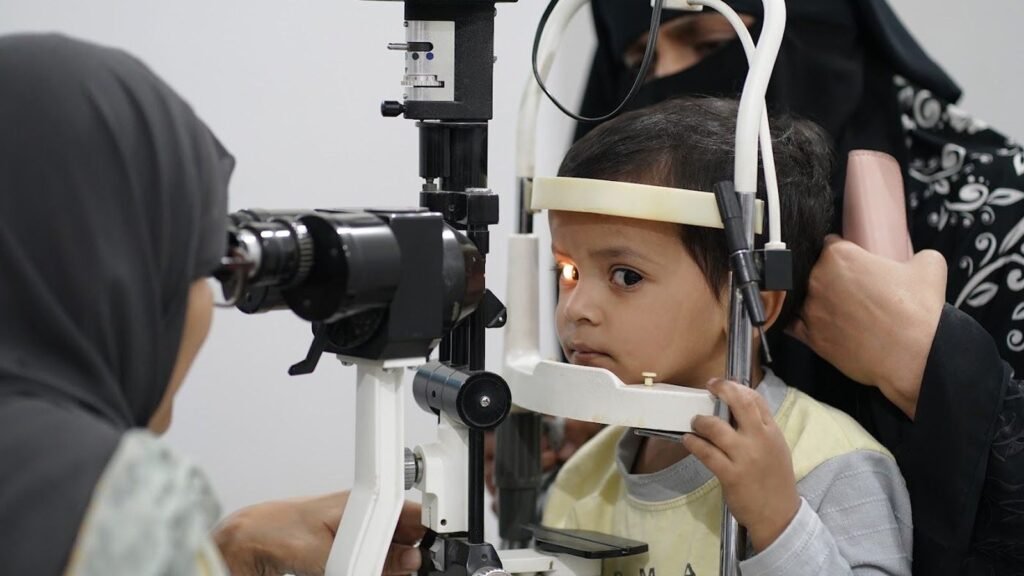
Most parents remember the moment. A child looks up from a toy or a book, and one eye seems to be looking somewhere else. It might last a second or it might be there all the time. Squint in children is common, and it is easy to dismiss as something the child will grow out of. Often that is a mistake. This guide explains what a squint is, what causes it, what to watch for and how it is treated, using the patient information from the American Academy of Ophthalmology and the NHS.
What a squint is
A squint is also called strabismus. It means the eyes are not lined up properly, so they point in different directions. One eye may look straight ahead while the other turns inward, outward, upward or downward. The turn can happen all the time or come and go. In some children it shifts from one eye to the other.
The Academy’s guide to strabismus in children describes three common types. In esotropia, an eye turns in toward the nose. In exotropia, an eye drifts out toward the ear. In hypertropia, one eye points higher than the other.
Why the eyes need to work as a pair
Each eye has six small muscles attached to it. They move the eye right, left, up, down and at an angle. For a person to see a single clear picture, all of the muscles in both eyes must work together.
When the eyes are lined up, each one sends the brain a similar image. The brain combines the two into one picture, and it is this combining that gives a person a sense of depth, or how near or far something is.
When one eye is out of line, the two eyes send different signals. In a young child the brain learns to ignore the picture from the eye that is out of line. It sees only the image from the straighter, better eye. Depth perception can suffer as a result.
Ignoring one eye also has a second effect. The Academy explains that a condition called amblyopia, or lazy eye, can develop. The eye that is out of line becomes the weaker eye. If the eyes are lined up during childhood, vision should develop well. If they are not, one eye may fall behind.
What causes a squint in a child
There are many reasons a child’s eyes may point in different directions, and sometimes no clear reason is found. The Academy and the NHS name these.
- A need for glasses. One of the most common causes is short sight or long sight. If a child’s vision is blurry, the eyes may have to strain to see clearly, and the strain can make them cross or drift apart. The NHS adds astigmatism to this list.
- Premature birth. Babies born early are more likely to have a squint.
- Conditions of the brain or nerves. The Academy lists neurological disorders, and both sources name Down syndrome. The NHS also mentions cerebral palsy and developmental delay.
- A cataract or an eye injury. Either one can lead to a squint.
- Family history. Having relatives with a squint raises a child’s chance of having one.
- Some infections. The NHS says rarer causes include infections such as measles.
In many children a squint appears with no obvious cause at all. That is another reason not to look for someone to blame.
Signs you may notice at home
The clearest sign is the one parents notice first. The eyes look in different directions at the same time. Other signs are quieter.
- The child closes or covers one eye when looking at something.
- The child tilts the head, or regularly turns it to one side, to look at an object.
- The turn comes and goes, rather than being there all the time.
The Academy explains that closing one eye or tilting the head may be the child’s way of getting both eyes to work together. The NHS lists the same two habits as signs of a problem. A teacher, a school nurse or a doctor may spot a squint before the family does, so it is worth listening when someone else raises it. A guide on the signs a child cannot see the blackboard covers other behaviours that point to a vision problem at school.
When a baby’s eyes only look crossed
Not every crossed-looking eye is a squint. The Academy describes a condition called pseudostrabismus. In children under one year old, the eyes can look crossed when they really are not. It usually happens when a baby has a wide, flat nose or a fold of skin at the inner corner of the eyelid. A child can outgrow pseudostrabismus, but not a true squint.
The Academy’s page includes photographs that show the difference. In pseudostrabismus, the reflection of a light sits in the same place in both eyes. In the true squint that is shown, the reflection is off centre in one eye. A doctor still has to examine the child. This is not a home test, and no parent should use a photograph to decide that an examination is not needed.
The NHS gives a useful rule about timing. In babies younger than three months, a squint that comes and goes is common and usually not a cause for concern. After three months of age, a squint that comes and goes should be checked. A squint that is there all the time should always be checked.
Why waiting is not a good plan
The NHS is direct about this. Treatment is usually recommended for a squint, because it is unlikely to get better on its own and it could cause further problems if it is not treated early. Those problems include blurred or double vision that does not go away, a lazy eye, and embarrassment or low self-esteem.
The lazy eye is the most serious one for eyesight. The brain starts to ignore the signals from the affected eye, so the child does not develop normal vision in it. Surgery can still improve the alignment of the eyes even when a squint has been left for a long time. But the NHS warns that any vision problems may be permanent if they are not treated at a young age.
There is a second reason to have every squint examined. The NHS notes that a squint can sometimes be a symptom of a rare type of childhood eye cancer called retinoblastoma. It is rare, and most squints have other causes. But an examination is how that possibility is ruled out.
How a squint is treated
The right treatment depends on the cause, and the child’s eye specialist will choose it. The usual options are these.
- Glasses. If the squint comes from a focusing problem, glasses can improve the alignment. The Academy says some children’s eyes straighten when blurry vision is corrected.
- Patching or eye drops. These strengthen the weaker eye, which makes it easier for the child to hold the eyes straight. If a lazy eye has developed, the NHS says it may need to be treated first, usually by wearing a patch over the stronger eye.
- Eye exercises. Exercises for the muscles that control eye movement may sometimes help the eyes work together better.
- Injections into the eye muscles. The NHS says these weaken the muscles to help the eyes line up, but the effect usually lasts less than three months.
- Surgery. This is done on the eye muscles to line the eyes up.
What squint surgery involves
Families are often frightened by the word surgery, so it helps to know the outline. The Academy explains that children’s eye specialists are trained to do this operation on young eyes. The child is fully asleep under general anaesthetic. The surgeon makes a small opening in the thin tissue that covers the eye and finds the muscles. A muscle can be weakened so that it pulls less, or tightened so that it pulls harder. This may be done on one eye or both. Some children need more than one operation.
Recovery is usually quick. The Academy says most children can return to their daily routine in about two to three days. As with any operation, there are risks. They are rare, but they can be serious, and the surgeon will talk them through before the operation.
One point is easy to miss. Surgery does not replace glasses, patching or blurring if the specialist recommends those too. The operation changes how the eyes line up. It does not remove the need to build up vision in a weaker eye.
Questions to ask at the appointment
- What type of squint does my child have, and what is the likely cause?
- Is the vision in both eyes the same, and is there any sign of a lazy eye?
- Does my child need glasses, and how long should they be worn each day?
- If patching is advised, which eye is covered, for how long and for how many weeks?
- When should my child be seen again, and what should I watch for in between?
- Is any other member of the family at risk?
Write the answers down, and ask for the plan in writing. When more than one adult looks after the child, everyone should know the routine.
Helping your child along the way
Glasses and patches only help when they are worn as the specialist advises. A calm, regular routine makes that easier. Tell the child’s teacher what the specialist has advised, so the child is not teased or left alone with a difficult routine at school. More guides for parents are collected in the children’s vision section of this site.
What to do next
If a child’s eyes look different from each other, or if a squint seems to be getting more frequent, book an eye examination. Do not wait for the next school check. For questions about a child’s squint, ask PEBS about squint in children. Families who would like to give can review the hospital’s donation methods.
A child whose brain is ignoring one eye will not complain about it, so the first examination depends on an adult who noticed.
Have a question about your eyes?
PEBS Hospital in North Karachi can examine you and explain your options. Call the helpline on 021-36908053, or send a message and the team will reply.
This article is general information and does not replace an examination by an eye doctor.
