Hyperopia in children, also called long-sightedness, makes it harder to focus on nearby objects. Some children describe blur; others move books away, become tired during close work or say little. An optometrist can test how each eye focuses and explain whether glasses or review may help.
The NHS guide to long-sightedness and hyperopia explains how an eye test can check focus and how glasses or contact lenses may correct vision. In young children, severe long-sightedness can be associated with other vision problems, including a squint or lazy eye. An optometrist can examine the child and explain whether a prescription is needed.
What hyperopia means
Clear sight depends on light being focused accurately on the retina at the back of the eye. Hyperopia occurs when the eye does not focus nearby objects properly. The shape of the eye, the cornea at the front or the lens inside the eye can affect focus. The word ?long-sighted? can be confusing because it does not mean that every child sees distant objects perfectly.
The term does not tell a family how clearly a child sees at every distance. The task where blur or strain appears is useful to describe, but it cannot show the amount of long-sightedness. An eye test measures the refractive error and checks whether it affects one eye or both.
Children may not describe blur in the same way an adult would. Some may say that words or pictures look fuzzy. Others may move a book farther away, feel tired during close work or get headaches after a task that needs sustained focus. These signs can have other causes, so they are reasons to arrange an eye test rather than evidence of hyperopia on their own.
Try to give examples rather than label the problem. Note which close tasks seem difficult, how long the child can continue and whether they feel better after stopping. If a teacher notices a squint or a struggle with near work, share that detail with the optometrist. Classroom observations can guide the questions without becoming a diagnosis.
A child who can recognise letters on a classroom board may still have difficulty with a book at a desk. Distance vision and near focusing are different tasks. Describe both when asking for an assessment. The clinician can check how each eye focuses and whether the child’s sight is affected at different distances.
What a family might notice
Watch for patterns during reading, drawing or looking at a screen. A child may move material farther away to make it clearer. They may pause often, rub their eyes or say that near work makes them tired. Some children mention headaches. Other children say very little and simply avoid a task that feels uncomfortable.
Notice when the sign appears and how long it lasts. Does the child report blur with books but not with a ball game? Do headaches follow long periods of close work? Does one eye seem to turn in? Such details help the optometrist understand what to test. They do not replace a professional examination.
A squint or a difference between the two eyes should be discussed with an eye professional. Severe long-sightedness in a young child can be associated with a lazy eye or squint. The NHS advises an optician’s assessment when a parent notices signs of long-sightedness in a child. Do not wait for the child to complain before asking what is appropriate.
How an eye test checks focus
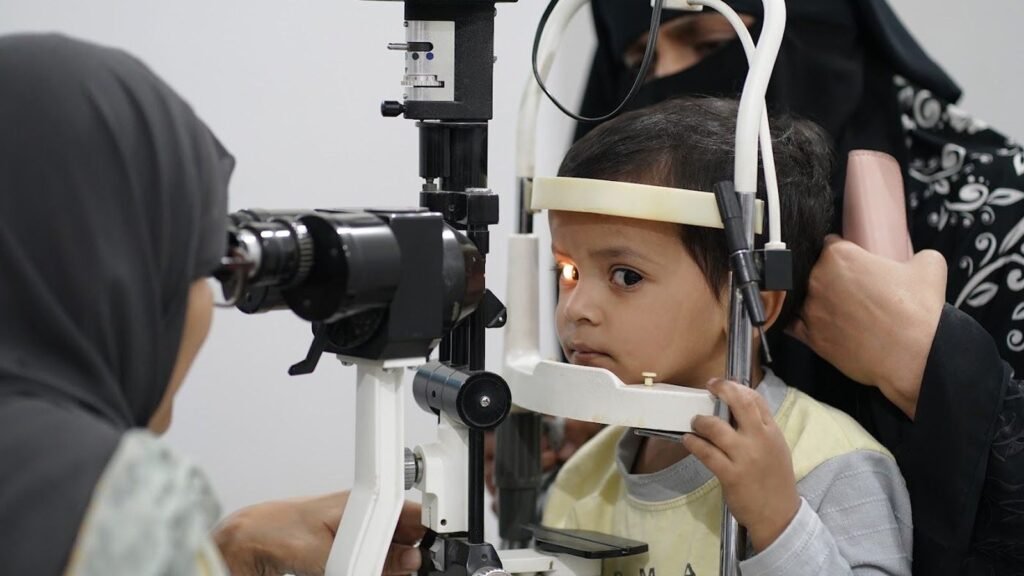
An optometrist can test whether the child is long-sighted. The NHS describes a test in which the person looks at lights or reads letters while different lenses are placed in front of the eyes. Each lens changes the focus, helping the optometrist measure how the eye is working.
The specialist may also shine a light into the eye to check its health. Eye drops can sometimes be used to let the clinician see the back of the eye more clearly. A parent can ask why drops are recommended, how long their effect may last and whether the child needs help travelling home afterwards.
Bring any existing glasses and tell the optometrist about symptoms, school observations and family questions. If the child wears glasses, mention how often they use them and whether they seem to help. The clinician can check the prescription and explain whether the current pair remains suitable.
Ask the optometrist to explain what the prescription means and whether glasses should be worn throughout the day or for particular tasks. The right routine depends on the child’s examination. Do not copy a relative’s prescription or choose a ready-made lens by age; an eye test measures what that child needs.
When glasses may be advised
Glasses can help focus nearby objects clearly. An optometrist will explain the prescription and whether the child needs to wear it all the time or for particular activities. Follow the instructions given for that child. A number on a prescription cannot be interpreted without the examination and the child’s visual needs.
Contact lenses are not suitable for everyone. The NHS says they are usually intended for adults and may not be suitable for some people. A family should not choose contact lenses for a child without discussing age, handling, hygiene and suitability with an eye-care professional.
If a child is given glasses, ask how to check that the frame sits comfortably and where to return if it becomes loose or damaged. For general information about the hospital’s school eye clinic, see the PEBS school eye clinic page. It is not a substitute for an individual prescription or fitting advice.
Hyperopia is not the same as every focusing problem
Long-sightedness is one type of refractive error. Other focusing problems can affect how someone sees near or far objects. The name of a condition matters because the examination and prescription depend on what the eye is doing. A general statement such as ?my child cannot see well? is a useful start, but the eye test identifies which part of vision needs help.
Some causes of long-sightedness relate to the shape of the eye or cornea. With age, the lens can also become stiffer and focusing nearby may become harder. An adult reading problem and a child’s refractive error are not automatically the same condition. A clinician can explain which factor applies in the person being examined.
Do not use an online chart or a relative’s glasses prescription to decide what a child needs. The correct lens strength is measured for the individual. Buying a ready-made pair may blur vision or fail to address the actual problem.
How to make the appointment useful
Before the eye test, write down what the child says and which tasks seem difficult. Tell the optometrist whether the child moves books away, feels tired during close work, reports a headache or has a visible eye turn. Mention whether the pattern is new or has been present for a while.
Ask what the test shows for each eye, whether any drops will be used, whether glasses are recommended and when the child should return. If a prescription is given, ask what signs would mean it needs an earlier review. A simple plan helps parents, carers and teachers use the same practical information.
For school, share only the relevant advice about glasses and near work. Do not ask a teacher to diagnose the cause of a child’s symptoms. If the child continues to struggle, tell the optometrist and ask whether another assessment is needed.
Questions families ask about hyperopia
Can a child see the board and still have near blur?
Yes. Long-sightedness affects the ability to focus on nearby objects, so distant and close tasks can feel different. A clear result on one task does not replace an eye test when close work is difficult.
Does moving a book away prove a child has hyperopia?
No. Moving work farther away can be a clue, but it does not confirm the cause. An optometrist measures how the eyes focus and checks whether another vision issue could explain the behaviour.
Will every child with hyperopia need glasses?
Not every child’s prescription or symptoms are the same. The optometrist explains whether glasses may help and how they should be used. Families should follow the advice for that child rather than choose a lens by guesswork.
Can severe long-sightedness affect a child’s sight?
The NHS says young children with severe long-sightedness are more likely to develop a squint or lazy eye. Ask the optometrist what the examination shows and when the child should be reviewed.
Are contact lenses suitable for young children?
The NHS says contact lenses are usually suitable only for adults and may not be right for everyone. A family should ask an eye-care professional before considering them for a child.
Why might drops be used during an eye test?
The optometrist may use drops to get a better view of the back of the eye. Ask why they are needed, what to expect afterwards and whether the child needs help travelling home.
Where to find PEBS information
The hospital services page describes the wider institution. For a PEBS enquiry, use the long-sightedness in children enquiry page and explain what you need to ask. Readers who wish to support PEBS can visit the donate page.
An eye test can turn a vague concern into a clearer explanation of how a child focuses and what support is appropriate. Bring the child’s observations, ask what the results mean and follow the clinician’s advice about glasses and review.
Have a question about your eyes?
PEBS Hospital in North Karachi can examine you and explain your options. Call the helpline on 021-36908053, or send a message and the team will reply.
This article is general information and does not replace an examination by an eye doctor.