
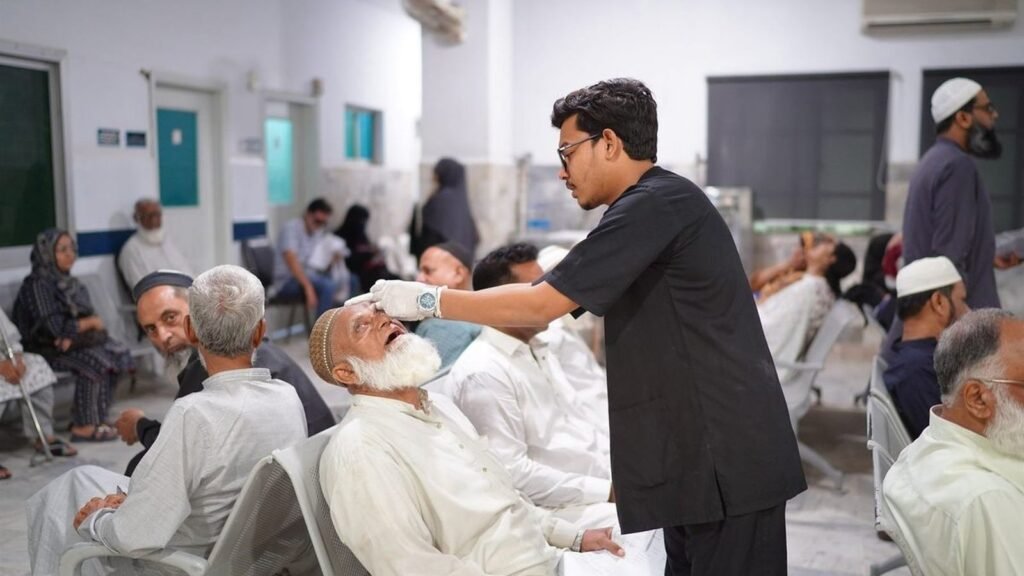
Eye injuries have a particular character that sets them apart from most other domestic and workplace accidents. They happen in an instant, to people who were doing something entirely routine, and what happens in the following few minutes frequently determines whether sight is preserved or lost. They are also, in the overwhelming majority of cases, preventable. That combination, preventable beforehand and time critical afterwards, is why they deserve more attention than they usually get.
Where they actually happen
Most people picture an industrial accident, and workplace injuries are certainly significant. But a very large share of serious eye injuries happen at home, during ordinary tasks nobody thinks of as hazardous. Cleaning with chemicals. Hammering, drilling or cutting. Cooking with hot oil. Gardening. Opening something under pressure. The American Academy of Ophthalmology publishes prevention guidance covering exactly these everyday situations, and the recurring theme is that the injured person almost never expected to be doing anything dangerous.
Why protection is so rarely worn
Eye protection is cheap, widely available and largely ignored, and the reason is psychological rather than practical. People assess the risk of the task rather than the consequence of the injury, and a five minute job feels too small to justify equipment. But the exposure that matters is not how long the task takes, it is whether a single fragment travels in a single unlucky direction. The five minute job is exactly where most of these injuries occur, precisely because nobody prepares for it.
Chemical splashes, where minutes decide everything
This is the injury where immediate action matters most and is most often mishandled. A chemical splash should be irrigated immediately with clean water, copiously, and for far longer than feels necessary, holding the lids open so the water actually reaches the surface. Alkaline substances, which include many common cleaning products, penetrate tissue and continue causing damage while people are looking for a phone number. The instinct to stop rinsing and go to hospital is understandable and usually wrong, because the rinsing is the treatment for those first minutes.
What not to do, and why people do it anyway
Several common responses actively worsen the outcome. Rubbing the eye, which grinds a foreign particle across the cornea. Trying to remove something embedded, which can turn a contained injury into a much worse one. Applying pressure to an eye that may be perforated, which risks pushing contents out. Using leftover drops from a previous condition, which may be entirely inappropriate. Applying home remedies to the surface of an injured eye. Each of these is a natural, well intentioned reaction, and each can convert a recoverable injury into a permanent one.
Blunt injury looks less serious than it is
An impact from a ball, an elbow or a fist may leave no visible wound and no bleeding, which is why blunt eye trauma is so frequently dismissed. The damage from these injuries is often internal, involving bleeding inside the eye, damage to the retina, or a rise in pressure that shows up hours later. Anyone with a significant blow to the eye should be examined even when they look and feel largely fine, because the important findings here are the ones that are invisible from outside.
The particular danger of small, fast fragments
The most deceptive injury of all involves a tiny, high speed fragment, typically produced by hammering metal on metal or by grinding. The entry point can be minute, the pain can be surprisingly mild, and the eye may look almost normal. Meanwhile a fragment sits inside the eye, where it can cause severe damage and infection. Anyone who was striking or grinding metal and then developed eye irritation should be assessed with that history stated explicitly, because it changes what the examiner looks for.
Children, and the injuries that recur
Certain childhood eye injuries appear again and again. Elastic cords and catapults. Pens, pencils and scissors carried while running. Fireworks. Air weapons and projectile toys. Chemicals reached from a low cupboard. None of this suggests children should be prevented from playing. It suggests that a small number of specific items account for a disproportionate share of serious injuries, and knowing which ones they are is what allows a household to be sensible without being restrictive.
What to do in the first ten minutes
For a chemical splash, irrigate immediately and abundantly with clean water and keep going. For a blow, apply a cold compress gently to the area around the eye without pressing on the eye itself. For a suspected penetrating injury, do not press, do not remove anything embedded, cover the eye with something rigid if available to prevent contact, and seek help urgently. For a loose particle on the surface, blinking and clean water are reasonable first steps, and persistent grittiness afterwards means it should be looked at.
Why the phrase wait and see is the risk
Eye injuries frequently feel better after a short while, as the initial shock and watering subside. That improvement is genuinely misleading, because several of the serious mechanisms are painless. The decision that most often costs sight is not a wrong treatment, it is a reasonable person deciding to see how it looks tomorrow. If there is any doubt at all, being examined and told it is minor is a good outcome, not a wasted trip. Questions about attending can be raised through direct contact.
Why one eye injured is two eyes at risk
Losing sight in one eye is serious, and the remaining eye immediately becomes something more than it was. It stops being a spare and becomes the only one, which changes the calculation on protective eyewear permanently. Anyone who has already lost vision in one eye should treat eye protection as non-negotiable for any task involving impact, chemicals or dust, because the consequence of a second injury is total rather than partial. This is the single group for whom the advice in this article is most urgent and, in practice, least often given.
The delay that happens for reasons other than judgement
People do not only delay because they misjudge the injury. They delay because getting to a hospital costs a day’s wages, because there is nobody to accompany them, because they do not know whether they will be asked to pay before being seen. Framing every delayed presentation as a failure of understanding misses most of what is actually happening. For a household on daily earnings, going to be told it is minor is a real cost, and that calculation is what needs changing.
What to tell the person examining the eye
The history matters as much as the examination, and it is frequently given badly under stress. Say exactly what the material was, what the person was doing, and how much time has passed. Metal striking metal, a chemical name from the container if it can be brought, whether anything was rinsed and for how long. These details change what an examiner looks for and how urgently, and a vague account of something going in the eye can lead to a serious injury being underestimated.
Why an injured eye is followed up, not just treated
Several of the serious consequences of eye trauma appear late rather than immediately. Pressure inside the eye can rise weeks after a blunt injury. A retina damaged by impact can detach later. Scarring develops as healing proceeds. This is why a person treated for an eye injury is asked to return even when the eye feels settled, and why a single reassuring visit is not the end of the matter. Sustained clinical follow up is the part most often abandoned once the pain stops, and it is where the late complications are caught.
Why prevention is genuinely the whole answer
Almost everything above describes damage control after something that should not have happened. Protective eyewear during any task involving impact, chemicals, dust or pressure prevents the overwhelming majority of these injuries outright. It is one of the highest return precautions available in ordinary life, and it is skipped constantly because the task felt too small to warrant it. Treating the injuries that do occur, including for people who cannot pay for emergency eye care, is what a donation supports.
Have a question about your eyes?
PEBS Hospital in North Karachi can examine you and explain your options. Call the helpline on 021-36908053, or send a message and the team will reply.
This article is general information and does not replace an examination by an eye doctor.