
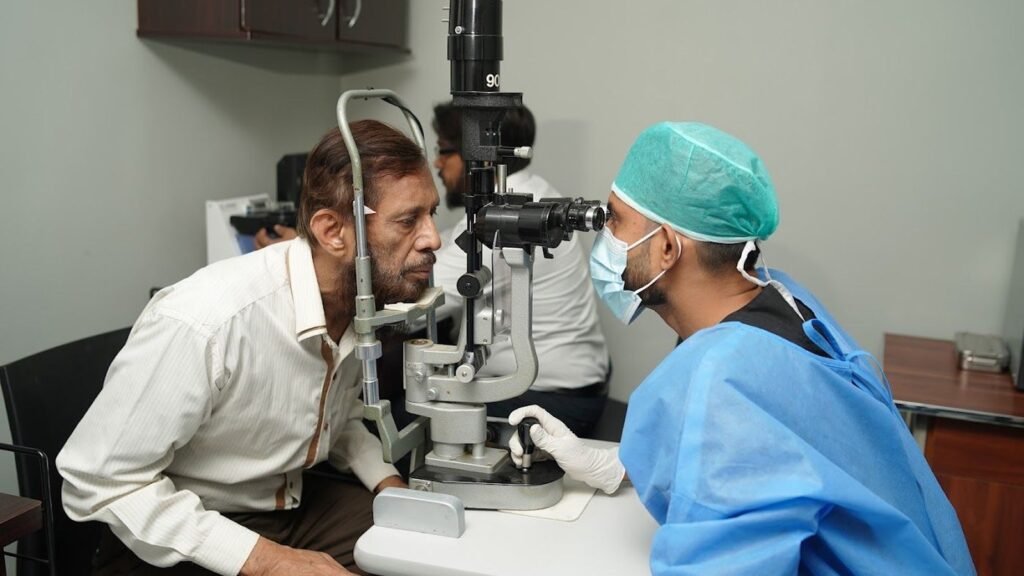
When a family in Karachi asks about a cornea transplant in Pakistan, they usually mean one specific thing. Someone has lost their sight because the clear front window of the eye has scarred or clouded over, and a surgeon replaces the damaged tissue with healthy tissue from a donor. This article explains what the cornea does, what goes wrong with it, and how a patient actually begins that conversation here.
What the cornea is
The National Eye Institute describes the cornea as the clear outer layer at the front of the eye, and explains that it helps the eye to focus light so you can see clearly. It is not something you notice in a mirror. It is transparent, and while it is healthy you never think about it at all.
Because it is transparent, everything depends on it staying that way. Light has to pass through the cornea before it reaches anything else. If the cornea clouds or scars, light is scattered or blocked before the rest of the eye gets a chance to do its work. The eye behind it can be in good order and the person still cannot see. PEBS calls this corneal blindness on its eye donation page, and states there that corneal blindness is treatable.
What damages a cornea
The National Eye Institute lists several common conditions that affect the cornea, and it is a shorter list than most people expect.
Injuries come first. The Institute notes that small abrasions, meaning scratches, usually heal on their own, but that deeper scratches or other injuries can cause corneal scarring and vision problems. Allergies, including allergic conjunctivitis, can make the eyes red, itchy and watery. Keratitis is inflammation, that is redness and swelling, of the cornea, and the Institute connects it to infections related to contact lenses. Dry eye happens when the eyes do not make enough tears to stay wet, which can be uncomfortable and may cause vision problems. Corneal dystrophies cause cloudy vision when material builds up on the cornea, and these usually run in families. The Institute also names less common diseases that affect the cornea, including ocular herpes, Stevens-Johnson syndrome, iridocorneal endothelial syndrome and pterygium.
Notice how ordinary most of that is. A scratch from a branch, a lens worn a day too long, an infection nobody took seriously. Corneal damage in this city rarely starts with something dramatic.
When not to wait for an appointment
Some eye problems can wait for an OPD slot. Some cannot. The National Eye Institute says to go to an eye doctor or the emergency room straight away if you have intense eye pain, a change in vision, blurry vision, very red and watery eyes, an object stuck in your eye, or a serious eye injury or trauma such as being hit hard in the eye. The Institute’s full page on corneal conditions is worth keeping to hand.
For the everyday version of this, the Institute gives plain advice. If something feels stuck in your eye, try blinking several times, try rinsing the eye with clean water or saline solution, and try pulling the upper eyelid down over the lower one. Do not rub the eye, because you could scratch the cornea. And if an object really is stuck in the eye, do not try to remove it yourself. Go to an eye doctor or the emergency room.
One local note on timing. PEBS publishes its hours as Monday to Saturday, 9:00 AM to 6:00 PM. Outside those hours, take an eye emergency to the nearest emergency department rather than waiting for the hospital to open in the morning.
How a cornea transplant works
Not every corneal condition needs surgery, and it helps to know that before you start worrying about one. The National Eye Institute notes that many corneal conditions can be treated with prescription eye drops or pills. For some corneal dystrophies and other conditions, it describes a laser treatment called phototherapeutic keratectomy, used to reshape the cornea, remove scar tissue and make vision clearer.
Where the damage to a cornea cannot be repaired, the Institute describes corneal transplant surgery as removing the damaged part and replacing it with healthy corneal tissue from a donor. It also describes an artificial cornea, called a keratoprosthesis, as an alternative to a transplant in some cases.
That one phrase, tissue from a donor, is the whole reason an eye bank exists. A cornea transplant in Pakistan is not possible without a donated cornea, and a donated cornea does not appear from nowhere. It comes from a person who pledged during their life, and from a family who honoured that pledge afterwards.
A transplant is surgery, and the risks belong in front of the patient rather than only in an article about the laboratory. On its own guidance about corneal transplants, the National Eye Institute states that like any surgery a corneal transplant has risks, and that one major risk is tissue rejection, when the body sees the new cornea as a foreign object and tries to get rid of it. It notes that a doctor can give medicine to help stop the rejection and save the cornea. It lists other eye problems the surgery can cause, including infection, bleeding from the eye, retinal detachment and glaucoma, and it states that a patient who has tissue rejection or other severe problems with the new cornea may need another transplant.
The same guidance names the signs of rejection that need attention immediately. Eye pain, sensitivity to light, red eyes, and cloudy or hazy vision after a corneal transplant should be reported to your eye doctor straight away.
On recovery, the Institute states that a corneal transplant is outpatient surgery, so a patient goes home the same day, that somebody else will need to drive them home, and that a follow up appointment is needed the day after surgery. Afterwards it describes using the eye drops the doctor prescribes, avoiding rubbing or pressing on the eye, and wearing glasses or a shield to protect it. And it states that depending on the type of transplant, it can take up to a year to recover fully. That is the part families most often do not expect, so plan for a year of appointments rather than a week.
What this article cannot tell you is how well it would go for you. No web page can. That depends on the eye, the condition, the tissue and the person, and it is a conversation for you and your surgeon, in a room, after an examination.
Where PEBS fits in
PEBS lists corneal transplantation among the surgeries performed by the Eye Unit at PEBS Hospital, alongside cataract surgery, vitreoretinal surgery, YAG laser procedures and DCR. The same page lists the Eye Unit’s diagnostic and clinical services as slit lamp evaluation, auto refraction testing, perimetry, puff tonometry, A and B scans and optical coherence tomography, and names Dr Kashif Farooqui as Head of Department.
The tissue side of the work sits with the PEBS Eye Bank and Cornea Lab. PEBS describes it as receiving, evaluating and preserving donated corneas, from local donors and from partners abroad, and supplying them to surgeons for sight restoring corneal transplants. PEBS states that more than 16,000 corneal grafts have been made possible through its work, and that more than 30,000 eyes have been pledged across Pakistan.
On money, PEBS publishes one figure and it is worth reading slowly. The Eye Bank page states that a corneal graft costs around PKR 200,000 to fund, and that through the Eye Bank, donors make complete grafts possible for patients who could never afford them. That figure is what it costs a donor to fund a graft for somebody else. It is not a quote handed to a patient, and it is not a price paid for tissue. A donor cannot name or choose the patient who receives a graft. There is no separate queue for patients funded by different donors, and which patient receives a cornea is a clinical decision about need and suitability. Money does not buy tissue and it does not buy priority.
How to start
PEBS publishes a single route and it is a simple one. If you or a family member may need a corneal transplant, call OPD on 021-36908053 to discuss assessment. Nothing is settled on a phone call. An assessment means an examination, and an examination is where a surgeon can say what is actually wrong with the eye and whether a graft is the right answer for it.
If you would rather write first, the contact page carries the hospital’s address at ST 19/7, Sector 14-B, Shadman Town, North Karachi, and its reception numbers.
Bring whoever normally comes to appointments with you. Decisions about a cornea transplant in Pakistan are family decisions in practice, and it saves a second trip.
Whatever you have read here, your eyes are not a general case. Speak to an eye specialist about your own eyes and book an appointment on 021-36908053.
Have a question about your eyes?
PEBS Hospital in North Karachi can examine you and explain your options. Call the helpline on 021-36908053, or send a message and the team will reply.
This article is general information and does not replace an examination by an eye doctor.
