
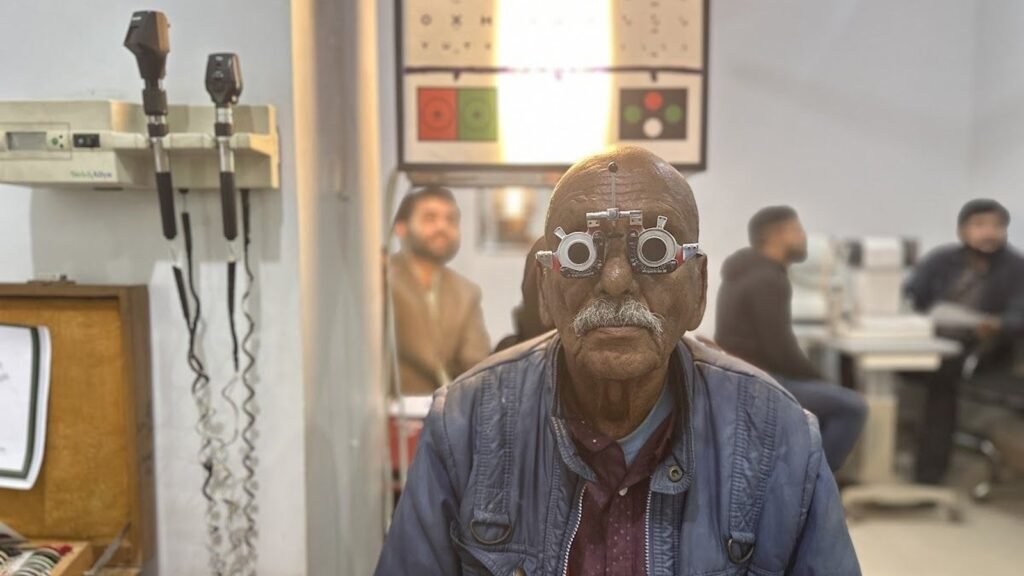
When vision goes soft at the edges, the first thing many people in Karachi say is that age has caught up with them. Sometimes that is true. Very often it is not. Blurred sight is frequently a refractive error, which is a focusing problem rather than a disease, and it is measured in a few painless minutes. This is a plain guide to what a refractive error is, who should have a refractive error test in Karachi, and what happens next if something is found.
What a refractive error actually is
The US National Eye Institute puts it simply. A refractive error happens when the shape of the eye stops light from focusing correctly on the retina, the light sensitive layer of tissue at the back of the eye. The cornea, the clear outer layer at the front, and the lens inside the eye both bend light so that it lands on the retina. When the shape changes, the light lands in the wrong place and the picture blurs. You can read the full explanation on the National Eye Institute page on refractive errors.
The same page names three causes. The length of the eyeball, when it grows too long or too short. The shape of the cornea. And the ageing of the lens. Not one of those is something a person did wrong. That is worth saying out loud, because many families arrive at a hospital carrying guilt about a child’s eyesight that they never needed to carry.
The four kinds, in plain words
The National Eye Institute lists four common types.
- Nearsightedness, or myopia. Far away things look blurry. The board at the front of the classroom, a number plate, the face of someone across the street.
- Farsightedness, or hyperopia. Nearby things look blurry.
- Astigmatism. Things can look blurry or distorted at both near and far distances.
- Presbyopia. It becomes hard for middle aged and older adults to see things up close. This is the one people mean when they joke that their arms have got too short for the newspaper.
All four are focusing problems, and all four are looked for in the same short examination.
The signs that get missed
Blurred vision is the main symptom. The National Eye Institute also lists double vision, hazy vision, seeing a glare or a halo around bright lights, squinting, headaches, eye strain when the eyes feel tired or sore, and trouble focusing while reading or looking at a computer.
Here is the part that matters most for families. The same page notes that some people do not notice the symptoms of a refractive error at all. Sight that has been slightly wrong for years feels normal, because there is nothing to compare it against. A child who has never seen a sharp blackboard does not know a blackboard is meant to be sharp. That is why an examination is worth more than a guess, and why waiting for a complaint is the wrong way to catch this.
Who should have a refractive error test in Karachi
The National Eye Institute states that anyone can have a refractive error, and that the risk is higher for people who have family members wearing glasses or contact lenses. It adds that most types, including nearsightedness, usually start in childhood, and that presbyopia is common in adults aged 45 and older.
Put practically, a test is sensible if a child is struggling to read the board, holds books very close, rubs the eyes a great deal or has started to slide backwards at school. It is sensible if reading or phone work has become tiring after the age of 45. It is sensible if glasses run in the family. And it is sensible if headaches or eye strain arrive at the end of every working day.
PEBS has its own figures on how often this turns up in Karachi schools. The School Eye Clinic page states that between May 2025 and June 2026 the programme visited 216 schools and examined 60,159 students, and that refractive errors were found in 14,701 of them, which the page gives as 24.44 per cent. Of those refractive errors, the page records 8,574 as myopia, 2,961 as hyperopia and 2,937 as astigmatism. It also records 3,337 children who were already using glasses. These are the hospital’s own screening numbers rather than a national estimate, but they describe roughly one child in four in the schools PEBS visited.
Why a school often spots this before a parent does
PEBS runs a Teacher’s Training Programme alongside the school screening, and its page states that more than 10,680 teachers have been trained and more than 105,000 children screened. The reasoning on that page is hard to argue with. Children rarely know that their own eyesight is the problem, and a teacher sees the same students every day, which makes the classroom the earliest realistic place to notice.
The page also states that schools interested in teacher training or an eye screening visit can call 021-36908053 or use the contact page. If you are a head teacher reading this, that is the whole process for asking.
What the school screening actually involves
The School Eye Clinic page sets out four steps. Students are registered and tested in a quiet, comfortable place for visual acuity using a Snellen chart and for colour vision using an Ishihara chart. A refractionist then runs an objective test on an auto refractor to detect refractive errors. An ophthalmologist performs a slit lamp examination and ophthalmoscopy to look for any other ocular disorder. If a problem is found, parents receive a referral to PEBS Hospital for full evaluation and treatment.
One honest note. That page states the treatment is provided at no cost, but it does not set out how eligibility is assessed or what a family should bring with them. We are not going to invent that detail. Ask the hospital about your own situation rather than assuming either way.
What a test at the hospital looks like
The PEBS Hospital page states that the Eye Unit was established in 1993, and lists its diagnostic and clinical services, which include auto refraction testing, slit lamp evaluation, perimetry, puff tonometry, A and B scans and optical coherence tomography. Not every patient needs every one of those. The ophthalmologist decides what a particular pair of eyes needs after looking at them.
The National Eye Institute describes the general shape of the examination as simple and painless. The doctor asks you to read letters up close and far away, and may put drops in the eye to widen the pupil so that the rest of the eye can be checked as well. If you are told drops will be used, plan for a slower trip home.
If a refractive error is found
The National Eye Institute states that eye doctors correct refractive errors with glasses or contact lenses, or fix the error with surgery, and that eyeglasses are the simplest and safest way to correct a refractive error. The PEBS School Eye Clinic page lists glasses, exercises or surgery for children who are referred after a full evaluation. Those two lists are not the same list. The National Eye Institute names glasses, contact lenses or surgery, and it does not name exercises as a treatment for a refractive error, so if your child is referred, ask the Eye Unit what exercises covers in that particular case.
Which route is right is not a decision a website can make, and this article will not pretend otherwise. It follows the examination, and it belongs to the ophthalmologist who carried the examination out.
When blurred vision is not a focusing problem
Most blur is a focusing problem. A small part of it is an emergency, and the difference is usually in how the blur arrived rather than in how bad it looks. Do not book an OPD appointment for any of the following. Go to the nearest hospital with an emergency department, the same day.
- Blur that came on suddenly, over minutes or hours, rather than over months
- Blur in one eye only
- Blur with pain, a red eye, nausea or vomiting
- Blur with new floating spots, flashes of light, or a curtain or shadow moving across the vision
- Blur after a blow to the eye or the head, or after something splashed into the eye
A refractive error does not behave like that. It creeps in over months and years and it affects both eyes more often than one. Anything that arrives quickly, hurts, or takes one eye on its own needs to be seen today, and outside hospital hours that means an emergency department rather than waiting for the OPD to open.
How to arrange a test
The contact page lists 021-36908053 as the reception line for OPD timing information, with that line given as 9 am to 4 pm, and the site states hospital hours of Monday to Saturday, 9:00 AM to 6:00 PM. The address on the same page is ST 19/7, Sector 14-B, Shadman Town, North Karachi. A refractive error test in Karachi begins with that call, so ask when the eye OPD is running before you travel, particularly if you are bringing an older relative or taking a child out of school.
If you would rather help another family get tested, the screening programme is funded by donors, and the donate page sets out the routes for giving.
The short version
Blurred vision has many causes, it is often nothing more than a focusing problem, and a focusing problem is one of the few things in medicine that can be identified quickly and corrected simply. Age is a reason to get tested, not a reason to accept blur. Do not settle the question from an article, including this one. If your sight has changed, or your child is struggling to see the board, speak to an eye specialist about your own eyes and call PEBS Hospital on 021-36908053 to ask about an appointment.
Have a question about your eyes?
PEBS Hospital in North Karachi can examine you and explain your options. Call the helpline on 021-36908053, or send a message and the team will reply.
This article is general information and does not replace an examination by an eye doctor.
