
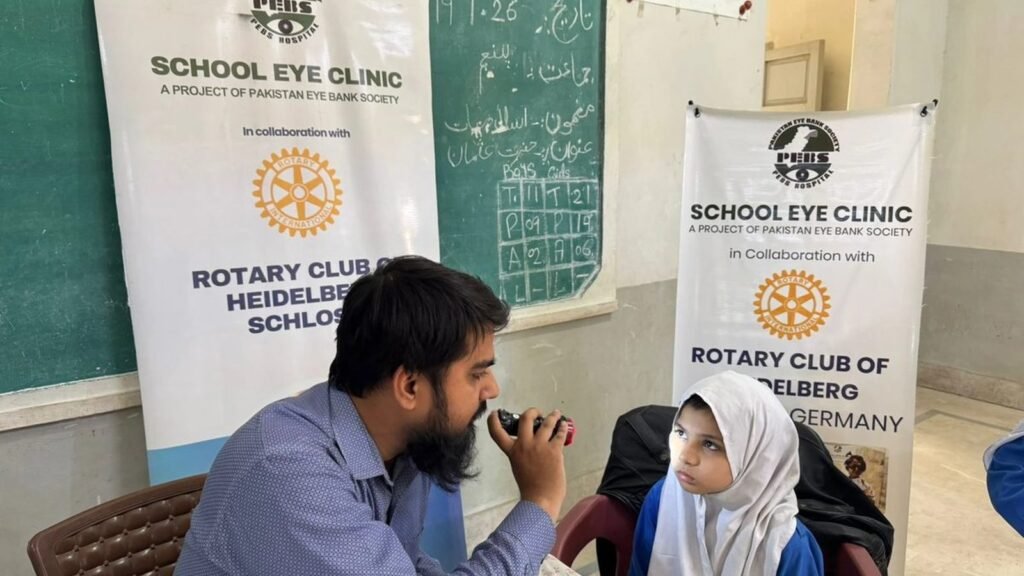
Albinism affects the body’s production of melanin, the pigment involved in the colour of skin, hair and eyes. It can also affect the development of sight. A child may need help with glare, focusing and seeing classroom work. The useful starting point is an eye assessment and a plan based on the child’s actual needs.
Appearance does not describe the whole condition
People with albinism produce less melanin, or none. Colouring varies. Some have very light hair, while others have brown or red hair. It is not possible to judge someone’s visual ability from hair colour.
Melanin also has a role in how the retina develops. This helps explain why albinism belongs in an eye care discussion as well as a discussion about skin. The retina is the light-sensitive tissue at the back of the eye.
The NHS describes albinism as lifelong and not progressively worsening by itself. Individual eye problems still need assessment and follow-up. New symptoms should not be dismissed because someone already has an inherited condition.
The two broad types
Oculocutaneous albinism affects skin, hair and eyes. It is commonly shortened to OCA. Ocular albinism mainly affects the eyes and may be shortened to OA.
These names help explain why two people with albinism may look different. They also matter when discussing inheritance. Different forms can pass through families in different ways.
Ask the medical team which type has been identified and whether testing would add useful information. If the type is not yet clear, ask what remains uncertain. A general description from a website cannot replace that individual assessment.
What the eye examination may find
Possible problems include short sight, long sight, astigmatism, sensitivity to light, uncontrolled eye movements and a squint. Some people have low vision that ordinary glasses cannot fully correct.
These are different findings. A focusing error affects the clarity of the image. A squint involves the direction the eyes point. Light sensitivity can make bright conditions uncomfortable even when the task is otherwise familiar.
Ask for each finding to be explained separately. Our guide to refractive errors and blurred vision explains focusing problems. Correcting one problem can be useful even when it does not remove every visual difficulty.
Why regular checks matter for children
As a child grows, the eye team can assess their vision and correction needs. Many children with albinism need glasses or contact lenses. Follow-up allows the prescription and practical difficulties to be reviewed.
A child may not know that another person sees the same task differently. Ask about what they find hard to see, and tell the clinician what happens at home or school. Examples are easier to act on than a description such as clumsy.
For a baby, the assessment may include examination by an ophthalmologist. In some cases, tests of the visual pathways are used. Ask the team what each proposed test is intended to answer and how the result could affect care.
Working with light sensitivity
Light sensitivity is also called photophobia. Sunglasses, tinted lenses and a broad-brimmed hat outdoors can help some people. The comfortable choice can differ from person to person.
Describe the situations that cause difficulty. A bright outdoor route, a window beside a desk and a screen are different settings. Ask the eye team about suitable options rather than choosing a tint solely because someone else likes it.
At school, make sure the teacher understands that glare can affect access to work. The child should be able to explain when a position or light source is uncomfortable. Adjustments can then be discussed around a specific task.
Reading aids and digital settings
Low vision aids may include magnifiers, larger print and stronger contrast. Some people use a small telescope to see writing at a distance. Larger screens and display magnification can also help.
Digital tools may offer speech output or speech-to-text options. These are different ways of accessing information. The most useful tool depends on the material and what the child can use comfortably.
Bring a real example to an assessment, such as a textbook page or worksheet. Ask which aid would help with that task. Buying a device before understanding the difficulty can leave a family with something that does not solve the problem.
Supporting participation at school
A child with albinism can attend mainstream school with appropriate support. The diagnosis does not determine ability to learn. What matters is making the material and activities accessible.
Tell the teacher about the child’s measured visual needs. Ask whether print, board work and digital material are readable. The separate guide to classroom signs of visual difficulty may help identify tasks worth discussing.
Keep the plan practical. Record which adjustment helps, who will provide it and when it should be reviewed. Listen to the child’s response as well as the adults’ observations. A change that looks helpful from across the room may not feel helpful to the person using it.
Understanding eye movement and a squint
Nystagmus is involuntary eye movement that can reduce visual clarity. The NHS explains that people with the usual albinism-associated pattern do not necessarily experience the surroundings as constantly moving. The brain adapts to the movement.
A squint means that the eyes point in different directions. Its treatment depends on the individual assessment. Some children may also need prescribed patching for amblyopia, where one eye’s vision has not developed as well.
Do not start exercises or patching based only on the appearance of the eyes. Ask which problem is being treated and follow the child’s own instructions. An approach useful for one diagnosis is not automatically useful for another.
Talking about inherited risk
Some forms are inherited when a child receives a changed gene from each parent. Parents can carry a genetic change without having the condition. Other forms follow an X-linked pattern, with different implications for sons and daughters.
Because the pattern depends on the type, ask about genetic counselling if you want to understand family risk. A counsellor can explain the findings in the context of your family. General percentages do not identify which pattern applies to you.
Bring any known family diagnoses or test results to that conversation. If the information is uncertain, say so. It is better to distinguish a confirmed diagnosis from a family recollection than to treat them as equivalent.
Skin protection belongs in the plan too
Reduced melanin in the skin increases susceptibility to sunburn and skin cancer. The NHS advises sun protection, suitable covering clothing and shade when the sun is strongest.
Its guidance recommends sunscreen with a sun-protection factor of at least thirty. Ask a clinician or pharmacist about suitable products and use. Eye comfort and skin protection are related outdoor concerns, but one does not replace the other.
Report new or changing skin marks, lumps or growths to a doctor. A changed patch of skin should not be assumed to be a routine part of albinism. The medical team can advise what needs assessment.
What to take away from a review
Before leaving, confirm the current prescription, the next eye check and any support recommended for school. Ask whom to contact about new symptoms or a practical difficulty with glasses or lenses.
Ask for a short written explanation that can be shared with the child’s teacher. It should describe the useful adjustments rather than make assumptions about academic ability. When the school tries a change, ask the child whether it actually helps. Bring that feedback to the next review so recommendations can be refined.
This guide is based on the NHS explanation of albinism. It is general education. For an enquiry about your case, use the PEBS enquiry page about albinism and eye care. If you would like to give, visit the donate page.
The plan should help the child use their sight comfortably and take part in learning, with support adjusted as their needs become clearer.
Have a question about your eyes?
PEBS Hospital in North Karachi can examine you and explain your options. Call the helpline on 021-36908053, or send a message and the team will reply.
This article is general information and does not replace an examination by an eye doctor.
