
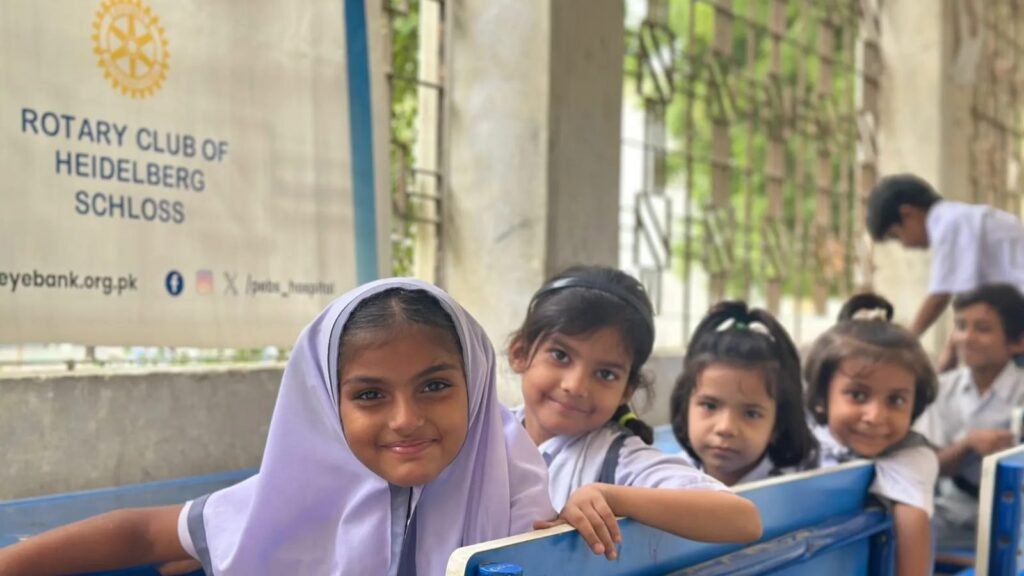
A child who squints at the board, sits close to the television or cannot see distant things clearly may be short-sighted. The medical name is myopia, and it often begins in the school years. Parents then ask two questions. Can it be slowed down? And what do the new treatments really offer? This guide looks at myopia in children, using the public advice of the College of Optometrists, and explains what myopia management is, what the evidence says and where its limits lie.
What myopia is
Myopia is also called short sight or near sight. A short-sighted child has problems seeing things in the distance clearly, but can see things that are close. There are different degrees of it.
The cause is usually the shape of the eye. Myopia is often due to the eye being slightly too long from front to back. For clear vision, light must focus directly on the retina, the light-sensitive tissue at the back of the eye. In myopia, light focuses in front of the retina, so distance vision is blurry.
When it starts and how it changes
The College explains that myopia usually starts in childhood, between six and 13 years of age. It tends to get worse until the eye has stopped growing. It can also develop in younger children and in adults. People are more likely to become myopic if their parents are myopic.
The College also lists a few things that may make it more likely that a child will become myopic. Having a parent with myopia is one. Spending limited time outside is another.
Signs to notice
A short-sighted child will have problems seeing things in the distance clearly without glasses or contact lenses. But the child will often see well close up. As a result the child may move closer to things or squint, narrowing the eyelids, to see them clearly. An optometrist can detect myopia during a sight test.
A guide to the signs a child cannot see the blackboard lists other clues at school, and a separate guide explains who should be tested for blurred vision.
What ordinary glasses do and do not do
The blurred vision in myopia is usually easy to correct with standard glasses or contact lenses. That is the first step.
There is one important limit. Standard glasses and contact lenses correct the blur, but they do not slow down how quickly myopia develops. That is the gap that myopia management is meant to fill.
What myopia management means
Trying to slow down how quickly myopia gets worse is called myopia management. Treatments have been developed for this, including specially designed contact lenses and glasses. The College says current evidence suggests that special contact lenses or glasses may reduce progression of myopia by 40% to 60%. The reduction is usually seen over one to three years, and most of the effect happens early in treatment. Treatment may need to be continued to keep the reduction.
If management is successful, a child grows up with a lower level of myopia than they would have had without it. In practice this may mean the following.
- The child may not depend on glasses as much.
- The glasses prescription will be lower.
- The glasses will be thinner and lighter.
The College is careful about what is claimed. Myopia management may reduce the risk of myopia-related eye problems in adulthood, but it will not take the risk away altogether. Being less myopic may make a child slightly less likely to be affected by serious eye conditions in future, but there is not yet enough evidence to be sure. It will take many more years of research to understand how successful management can be, including whether myopia starts to get worse again after treatment stops.
The treatment options
There are two main approaches, and both work by changing how light is focused on different parts of the retina while still giving clear vision.
- Specially designed glasses. They look the same as standard glasses but change the focus in the side vision. A child wears them in the same way as ordinary glasses.
- Soft contact lenses. A child wears these in a similar way to standard contact lenses. Vision may be slightly less clear than with traditional lenses.
- Orthokeratology lenses. These are rigid gas-permeable lenses that are worn overnight to alter the shape of the front of the eye, the cornea.
Is one better than another? Based on current research, orthokeratology lenses are the most effective at slowing the growth of the eye. Management glasses and management contact lenses have similar results in reducing the level of myopia.
Age and safety
There is no minimum age for starting myopia management. But for contact lens treatments the child must be old enough to look after the lenses carefully, and the optometrist will show them how. The College says children can be just as good as adults at using contact lenses.
Safety depends on the choice. Wearing management glasses has no more risks than wearing standard glasses. The risks of contact lenses used to manage myopia are similar to the risks of standard contact lenses. Some people have mild discomfort and occasional blurred vision. With any contact lens there is also a low risk of serious complications, such as corneal infections that may result in sight loss. The risk is higher when lenses are worn overnight, and orthokeratology lenses are more likely to cause discomfort, particularly in children.
For this reason a child who wears any contact lenses must follow the optometrist’s advice on hygiene and caring for the lenses. Regular contact lens check-ups matter too.
Weighing the pros and cons
The College sets out the advantages and disadvantages in plain terms.
- Management may slow the rate at which myopia gets worse, compared with standard correction.
- There may be a lower risk of myopia-related eye problems later in life.
- A lower level of myopia may mean less dependence on glasses or contact lenses, and thinner, lighter glasses.
- Vision may be slightly less clear for some children during treatment.
- There is a risk of complications from wearing contact lenses.
The evidence does not yet say whether the long-term benefits outweigh the risks. Even so, children with myopia who are being considered for standard glasses or contact lenses could also be considered for management treatments. A child will very likely still need glasses or contact lenses even if management works, but at a lower level of myopia than without it.
How you know whether it is working
The optometrist should explain how progress will be checked, depending on the child’s age. They may measure the growth of the eye and the level of myopia. They may use a calculator to predict the expected level of myopia and estimate how much the development has been reduced. The College admits that it is not possible to know for certain how much the myopia has been reduced.
A child may not respond as expected. In that case the child may need a different treatment, or a combination.
When can treatment stop? There is not yet enough evidence for clear guidance. Experts currently believe that children should stop myopia management in their late teens or when the level of myopia stabilises. Treatment may need to be restarted if myopia begins to get worse again.
Outdoor time and screens
The College says that spending time outdoors does appear to help prevent or delay myopia in children at higher risk of developing it. It also encourages an active lifestyle, which is good for general health.
Screens are less clear. It is not certain whether near activities, such as reading or using a screen or mobile device, are linked with myopia. Some studies show a link with the time spent, and others show that cutting down near activities does not reduce myopia or slow its progress. Yet long periods of near work can take away from time outdoors, and that matters. Taking regular breaks, and reducing non-essential screen use, can also keep the eyes comfortable.
If you decide against it
A child who is not given myopia management will still be prescribed traditional glasses or contact lenses. These improve how well the child sees, but they will not slow progression. The College adds that such a child may be at a slightly higher risk of conditions that can lead to sight loss later in life, compared with people with normal vision. These conditions can be treated, and the risk of developing them is small.
Questions to ask the optometrist
- Is my child’s myopia likely to get worse, and how fast?
- Is my child suitable for myopia management, and which type would you suggest?
- How will you check whether it is working?
- What are the risks of the lenses, and how should they be kept clean and safe?
- How often should my child be seen?
The children’s vision section collects further guides for parents.
Asking for an eye test for your child
If a child squints, sits close to the television or complains that the board is blurred, arrange an eye test. For questions about a child’s short sight, ask PEBS about myopia management. Those who wish to give can review ways to support patient care.
Time outdoors and a proper eye test are the two simple steps that any family can take, whichever treatment is chosen.
Have a question about your eyes?
PEBS Hospital in North Karachi can examine you and explain your options. Call the helpline on 021-36908053, or send a message and the team will reply.
This article is general information and does not replace an examination by an eye doctor.
