
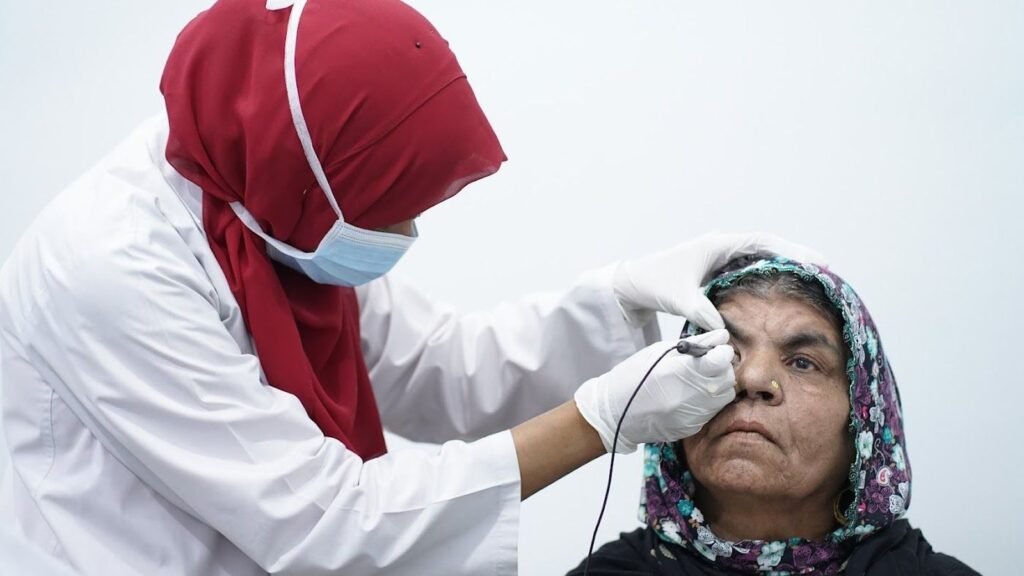
Almost everyone has had a red eye. Most of the time it is a nuisance that settles in a few days. Now and then it is the first sign of something that can damage sight. The NHS tells people not to try to diagnose a red eye themselves. This guide draws together the NHS advice on a red eye, a watering eye and a painful eye, and explains what can wait, what to do at home and which signs mean a person should be seen by a doctor the same day.
What a red eye can mean
The NHS page on a red eye says that it is usually nothing to worry about and often gets better on its own. A red eye is often caused by an infection or dry eyes, but there are many possible causes. It gives a guide to the common ones, with the symptoms that go with them.
- A bright red area in the white of the eye. A burst blood vessel.
- A gritty or burning feeling and sticky eyes. Conjunctivitis.
- Sore, blurry or watery eyes. Dry eyes.
- Itchy, sore or red, crusted eyelids. Blepharitis.
- A feeling that something is in the eye, or a problem with the eyelashes. An ingrowing eyelash.
- A swollen, drooping or twitching eyelid, or a lump on the eyelid. An eyelid problem.
The advice is repeated on the NHS page on eye pain. Do not try to diagnose the cause yourself.
When a red eye can wait
If the eye does not hurt, the sight is not affected and the person does not feel sick or unwell, the NHS says it is probably nothing serious. It may get better on its own in a few days. Until it does, there are two simple rules.
- Try not to touch or rub the eye.
- Do not wear contact lenses.
The NHS also suggests asking a pharmacist whether anything can be done at home, whether anything can be bought to help, and whether a doctor or optician needs to be seen. Whoever you ask, mention any pain, any change in your sight and the fact that you wear contact lenses. A guide to blepharitis and eyelid cleaning describes the cause of red, crusted eyelids in more detail.
When to see a doctor or optician soon
The NHS lists situations in which a person should not wait for it to pass but should arrange a visit.
- A child under two years old has a red eye.
- The red eyes come with a sticky discharge.
- There are red patches in the eye, or a problem with the eyelids or eyelashes, that last for more than a few days.
- You are worried about your eyes.
If the doctor or optician cannot find the cause, they may refer the person to an eye specialist for tests.
Signs that mean urgent care the same day
Three situations are on the NHS list of urgent signs for a red eye.
- A baby less than 28 days old has red eyes.
- The eye is very painful and red.
- A person who wears contact lenses has a red eye. This could be an eye infection.
The NHS gives the reason for the contact lens rule. A red eye in a lens wearer could be an eye infection. If you wear lenses and your eye is red, take the lenses out and ask to be seen.
Emergency signs
The NHS says to seek immediate help from an emergency service when a red eye comes with changes to sight, such as wavy lines, flashing or loss of vision. Its page on eye pain lists more situations that need immediate action. They are as follows.
- Symptoms that start suddenly.
- Pain that keeps you awake at night.
- Pain and loss of vision in a person who wears contact lenses.
- A red eye with a severe headache and feeling sick.
- Severe pain or loss of vision within four weeks of eye surgery or treatment.
- Loss of vision.
- An injury to the eye, or a pierced eye.
- Something stuck in the eye, such as glass or grit.
Getting there is part of the plan. The NHS says not to drive yourself. Ask someone to take you, and bring any medicines you take. A guide to glaucoma, the sight loss you do not feel, describes the sudden kind of glaucoma, which causes eye pain, nausea and a red eye.
What causes eye pain
The NHS says eye pain can be felt behind, inside or around the eye. It is common and usually nothing to worry about, but it can be serious. Its page lists possible causes.
- Something in the eye, such as dirt or an insect, or a scratch on the surface. This gives a painful, watering eye, blurred vision and a feeling that something is in the eye.
- Conjunctivitis, with a gritty or burning feeling and sticky eyes.
- Dry eyes, which are sore, blurry or watery.
- Cluster headache, with sharp, burning or piercing pain around the eye.
- An infection, such as one caused by wearing contact lenses or a herpes simplex eye infection, with pain, red eyes, blurred vision and sensitivity to light.
- Glaucoma, with tenderness around the eyes and changes in vision.
- Uveitis, a rare condition that causes inflammation inside part of the eye, with pain that is worse when reading, watering eyes and vision changes.
The NHS asks for an urgent appointment when the pain is severe, when there is sensitivity to light, when vision changes, or when one or both eyes are very red.
Watering eyes
Watering eyes are common and often get better on their own, although treatment may be needed if the watering interferes with daily activities. The NHS says it is normal for the eyes to water in smoky places, or outside in the cold or wind. An injury or something in the eye, such as an eyelash or grit, can also make the eyes water.
Other causes include blocked tear ducts, an allergy or infection such as conjunctivitis, an eyelid that droops away from the eye, and other eyelid problems. Dry eyes can also cause watering, because they make the eyes produce too many tears. Bell’s palsy, some medicines and cancer treatments are on the list too. Babies sometimes have watering eyes because their tear ducts have not fully developed, and this usually gets better in a few weeks.
Treatment depends on the cause. Drops, gels, ointments or sprays help when the eyes are dry. Antibiotic drops help in an eye infection. Medicines help in allergy. Anything stuck in the eye can be removed. A small operation may be needed for an eyelid problem or blocked tear ducts. The NHS says to see a doctor if the watering stops you doing everyday activities, if an eyelid turns inwards or droops away from the eye, or if there are lumps or swellings around the eyes that have not got better.
Lumps and swellings on the eyelid
The NHS says that most eyelid problems are harmless. These are fairly common and often settle by themselves.
- A lump that goes away by itself after several days or weeks.
- Mildly itchy, flaky or sticky eyelids.
- Swelling from a nearby insect bite, injury or operation that goes away after a week or so.
- Twitching or blinking from time to time, often when tired.
- Eyelids that droop, or become more hooded, with age.
A lump or swelling on the eyelid is most likely a stye or a meibomian cyst, which is also called a chalazion. A stye is a small painful lump on or inside the eyelid, and the NHS says styes are common and should go away within a week. A warm flannel held to the eye for five to ten minutes, two to four times a day, helps. Do not try to burst a stye.
Some eyelid signs are urgent. They are a swollen eyelid that is red, hot, painful, tender or blistered, an eyelid that suddenly droops, being unable to open the eye or keep it open, pain in the eye itself and not the lid, a very red white of the eye, eye symptoms with a headache or sickness, and a newborn baby with a sticky, red eye.
Conjunctivitis, and how to stop it spreading
Conjunctivitis is also called red or pink eye. It is caused by infection or allergies, and it usually clears in a couple of weeks without treatment. It usually affects both eyes. They look red and may burn or feel gritty, itch, water and produce pus that sticks to the lashes. Conjunctivitis that produces sticky pus is contagious. If the eyes are red and gritty it is also usually contagious. Conjunctivitis caused by allergies makes the eyes red and watery but is not contagious.
- Clean the eyelids with water that has been boiled and cooled, wiping the lashes gently with a clean cotton wool pad, one piece for each eye.
- Hold a cold flannel on the eyes for a few minutes.
- Do not wear contact lenses until the eyes are better.
To stop it spreading, wash your hands regularly with warm soapy water, wash pillow cases and face cloths in hot water with detergent, and cover your mouth and nose when sneezing. Do not share towels or pillows, and do not rub your eyes. See a doctor if the symptoms have not cleared up within seven days, or urgently if there is pain in the eyes, sensitivity to light, changes in vision or very red eyes.
If drops are prescribed
Many red eye problems end with a drop of some kind. The practical steps are covered in a guide to putting in eye drops safely. Tell the prescriber about contact lenses before any drops are used.
Asking about your own eyes
If you have a red, watering or painful eye that does not fit the early advice above, have it examined. For general questions about red-eye symptoms, ask PEBS about a red or painful eye. Readers wishing to give can review ways to support the hospital’s care.
Most red eyes pass, but pain, a change in sight or contact lenses turn a nuisance into a reason to go today.
Have a question about your eyes?
PEBS Hospital in North Karachi can examine you and explain your options. Call the helpline on 021-36908053, or send a message and the team will reply.
This article is general information and does not replace an examination by an eye doctor.
