
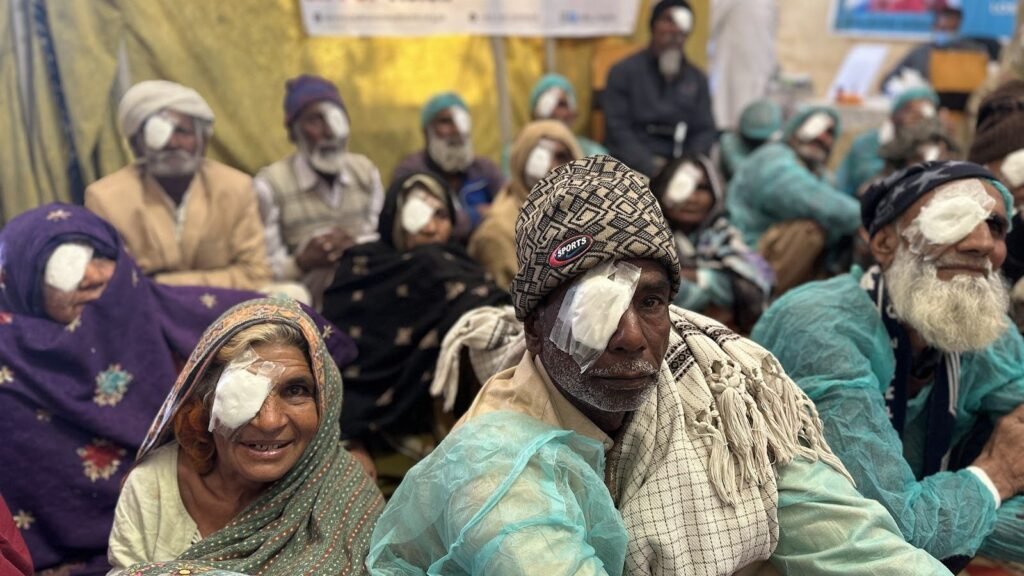
There is a single fact underneath almost everything an eye charity does, and most people have never heard it. The majority of blindness in the world did not have to happen. It is not the unavoidable consequence of age, or bad luck, or a body wearing out. It is, in most cases, either something that could have been prevented or something that can still be treated. Once you know that, the question stops being whether sight loss is sad and becomes why so much of it is still allowed to stand.
What avoidable actually means
The word gets used loosely, so it is worth being precise. Avoidable sight loss covers two separate things. The first is preventable, meaning the condition need never have developed, because the cause was known and could have been interrupted. The second is treatable, meaning the condition did develop but sight can be restored or the loss halted with care that already exists. The International Agency for the Prevention of Blindness uses this distinction throughout its work, and it matters because the two require entirely different responses.
Why this is not the same as saying it is anyone’s fault
Avoidable is a description of the condition, not a judgement of the person. Somebody who loses sight to an untreated cataract has not made a mistake. They have usually lived a long way from a hospital, or could not afford the operation, or was never told that the cloudiness was fixable at all. The word describes what medicine can do, not what a patient failed to do, and reading it any other way misses the point entirely.
The two conditions that dominate the picture
Two causes account for a very large share of the world’s avoidable sight loss, and both are unglamorous. The first is cataract, a clouding of the lens inside the eye, which is reversible with an operation that has been performed for decades. The second is uncorrected refractive error, which in plain terms means a person needs glasses and does not have them. Neither requires a research breakthrough. Both require somebody to reach the person.
Why the simplest problems persist the longest
It seems strange that the most fixable conditions are the ones that go unfixed at the largest scale. The explanation is not medical. A cataract operation needs a functioning theatre, a trained surgeon, a way for the patient to get there, and a way for them to afford it. A pair of glasses needs an eye test, a prescription, a lens and a frame. Each of those links is ordinary, and the chain breaks wherever the local resources run out. The bottleneck is access, not knowledge.
The conditions that are prevented rather than treated
Other causes sit on the preventable side. Some infections that damage the eye can be stopped with treatment given early enough. Nutritional deficiency in childhood can be corrected before it takes sight. Injuries can be avoided with protection at work and care at home. Diabetes-related damage to the retina can be caught before it progresses if somebody is looking for it annually. In each case the intervention arrives before the damage, which is always cheaper and always better than repairing it afterwards.
Where sight loss falls hardest
Avoidable blindness is not distributed evenly. It concentrates in places where eye care is furthest away, hardest to pay for, or simply absent. That is why the same condition produces a minor inconvenience in one country and permanent blindness in another. The disease is identical. The distance between the patient and the treatment is not.
Why this changes what giving means
If most blindness were untreatable, donating to eye care would be a matter of comfort and dignity, which would still be worth doing. Because most of it is avoidable, donation buys something more specific. It pays for the operation that reverses a cataract, the screening that catches damage early, the glasses that were never prescribed. The money does not fund a search for a cure that does not yet exist. It funds the delivery of treatment that already does.
The part that is easy to underestimate
Restoring sight to one adult rarely affects one life. A person who can see again can usually work again, move without a companion, and stop occupying the time of a family member who had been guiding them. The arithmetic of an eye operation runs outwards through a household in a way that is difficult to capture in a single figure, and it is the reason eye care is repeatedly identified as one of the more cost effective interventions in public health.
What it does not mean
Avoidable does not mean easy, and it does not mean every case can be reversed. Some sight loss is permanent by the time it is found, some conditions have no cure at present, and some eyes cannot be helped whatever is done. Presenting the picture as though every blind person could see tomorrow would be dishonest. The honest version is narrower and still remarkable, that a large share of the world’s blindness sits within reach of care that already exists.
Why the word blindness is narrower than people think
In everyday speech blindness means seeing nothing at all. In eye care it covers a range, and the great majority of people counted as blind or severely sight impaired retain some perception of light or shape. This matters for two reasons. It explains why someone can be registered as blind and still move around with apparent confidence, which sometimes causes suspicion it should not. And it explains why treatment that recovers partial vision is not a consolation prize. Going from unable to move independently to able to cross a room alone is an enormous change, even when it falls short of a full recovery.
Distance, cost and knowledge, in that order
When a treatable condition goes untreated, three obstacles usually explain it. The hospital is too far, and reaching it means a day of travel and lost earnings for a companion as well as the patient. The operation costs more than the household can absorb. Or nobody ever told the family the cloudiness was fixable, so it was accepted as ageing. Any one of these is enough to stop treatment on its own, and they very often arrive together in the same household.
Why women are affected more
Across many countries a disproportionate share of avoidable sight loss falls on women, and the reasons are structural rather than biological. Women are less likely to be taken for treatment, less likely to have money allocated to their care within a household, and less likely to be able to travel unaccompanied to a distant hospital. This is one of the reasons outreach that goes to the community rather than waiting for the community to come to it changes who actually gets treated.
The failure that happens after diagnosis
A screening that identifies a treatable problem has only done half the job. A significant share of people told they need a cataract operation never have one, because the referral required travel they could not arrange, or a payment they could not make, or simply because nobody followed up. Counting people screened is easy and counting people actually treated is harder, which is why the second number is the one worth asking about.
Why a camp reaches people a hospital never will
A hospital, however good, is a fixed point that people have to travel to. For a household where the nearest one is hours away and a day off work is not affordable, that fixed point may as well not exist. Screening that travels to a community inverts the problem, and the people it finds are frequently those who would never have presented at all. This is the logic behind outreach camps and medical camp work, and it is why coverage figures improve most when the service moves rather than when it simply expands where it already is.
The category money cannot solve
There is one form of avoidable blindness that funding alone does not fix. Where sight loss is caused by a clouded or scarred cornea, the treatment requires donated tissue, and no budget creates that. It comes only from people who decided during their lives that they were willing, and who told their families so. That is why eye donation sits slightly apart from every other item on the list. Everything else scales with resources. This one scales with how many people have had a short conversation at home.
The question this leaves
If the treatments exist, the surgery is routine and the cost per patient is modest, then the remaining obstacle is reach. Somebody has to run the clinic, staff the camp, screen the children, and cover the patient who cannot pay. That is unglamorous, repetitive work, and it is the entire difference between a treatable condition and a treated one. A donation is how most people take part in closing that distance.
Have a question about your eyes?
PEBS Hospital in North Karachi can examine you and explain your options. Call the helpline on 021-36908053, or send a message and the team will reply.
This article is general information and does not replace an examination by an eye doctor.
