
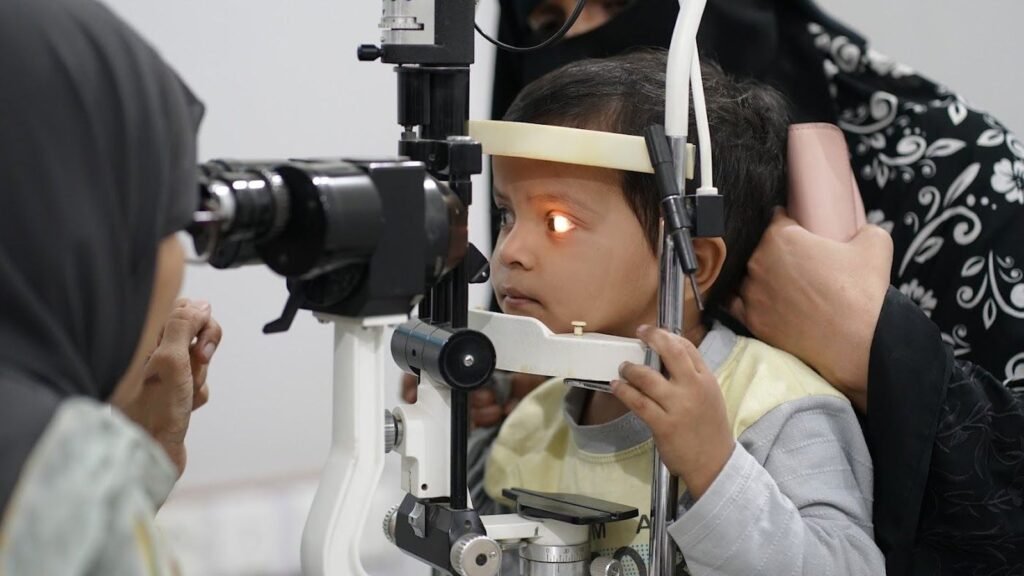
Most childhood eye problems can be dealt with whenever they are found. Amblyopia is the significant exception, and it is the reason eye screening in young children is treated with more urgency than parents often expect. Treated early, vision in the weaker eye usually improves. Left until later, the same treatment achieves considerably less, and eventually very little at all. The condition itself does not change. What changes is the brain’s ability to respond to treatment.
What amblyopia actually is
It is commonly called lazy eye, which is a misleading name, because the problem is not laziness and frequently is not really in the eye. Amblyopia is a failure of vision to develop properly in one eye during early childhood, and the failure occurs in the visual pathway of the brain rather than in the eye’s own structures. The National Eye Institute describes it as the most common cause of vision loss in children.
Why the brain is the part that matters
Sight is learned. A newborn’s visual system is not finished, and it develops through use during the early years. If one eye sends a clear image and the other sends a blurred or conflicting one, the brain increasingly relies on the good eye and progressively ignores the other. The weaker eye may be structurally fine. It is being disregarded, and with time that disregard becomes fixed.
The three usual causes
One eye may be significantly more short or long sighted than the other, so its image is permanently blurrier. The eyes may not point in the same direction, so the images cannot be combined and one is suppressed to avoid double vision. Or something may physically block vision in one eye during early life, such as a childhood cataract or a drooping lid. In every case the mechanism is the same, one eye supplies a worse signal and the brain gradually stops using it.
Why it is so easy to miss
This is the difficult part for parents. A child with amblyopia usually behaves completely normally, because the good eye is doing the work and the child has no idea anything is wrong. They have never experienced anything different, so they do not complain. Unless the eyes are visibly misaligned, there may be nothing at all to see from the outside. A child can reach school age with almost no usable vision in one eye and nobody, including the child, suspecting it.
What the window means in practice
Treatment works by forcing the brain to use the weaker eye, which depends on the visual system still being adaptable. That adaptability is greatest in early childhood and reduces as a child grows. This is why the same treatment that produces a good result at four produces a partial one later and a limited one later still. The urgency is not about the eye deteriorating. It is that the opportunity to retrain the brain narrows.
How it is treated
The first step is correcting the underlying problem, which frequently means glasses, and sometimes glasses alone are enough. Where more is needed, treatment involves making the brain rely on the weaker eye, most familiarly by patching the stronger one for part of the day. Where a physical obstruction is the cause, that is dealt with first. None of it is exotic, and that is precisely the frustration, because the treatment is straightforward and the only scarce resource is time.
Why patching is harder than it sounds
Covering a child’s good eye means deliberately making their vision worse for part of every day, and young children resist it for entirely understandable reasons. Families who understand why it is being done, and that the window is finite, tend to persist. Families who were handed a patch with no explanation frequently do not, and the treatment quietly stops working because it stopped being used.
What screening is for
Because the child shows no symptoms and the parents see nothing wrong, amblyopia is generally found by looking for it rather than by waiting for it to declare itself. That is the entire purpose of vision screening in young children, and it is why a check that seems unnecessary for a child with no complaints is worth doing anyway. It is one of the few tests where finding nothing is a normal and useful result.
What to look for at home
There is no reliable home test, but some things are worth noticing. An eye that turns in or out, even occasionally. A child who tilts their head consistently to look at something. Covering or closing one eye. Sitting unusually close to a screen. Any of these is a reason to have the eyes checked, not a reason to panic, and a check that finds nothing has cost very little.
Why one good eye hides the problem so completely
People are often puzzled that a child could have very poor vision in one eye and nobody notice. The explanation is that binocular vision is generous. With both eyes open, the good eye supplies almost everything needed for ordinary life, and the brain fills in the rest so smoothly that no gap is apparent. A child reads, plays, catches a ball and walks downstairs without difficulty. The only way to find the problem is to cover the good eye and test the other alone, which is precisely what a screening does and what daily life never does.
Squint is a symptom, not the whole condition
A visibly turned eye is the one sign families do notice, and it often prompts a consultation. But a squint is one possible cause of amblyopia rather than the condition itself, and the more dangerous cases are frequently the ones with no squint at all, where the eyes look perfectly straight and the difference is purely in focus. Parents sometimes take reassurance from straight eyes. It is not reassurance.
What treatment can and cannot achieve
It is worth being honest about outcomes. Early treatment frequently produces a substantial improvement, and sometimes a complete one. Treatment begun late may still produce some gain, and it is generally worth attempting rather than abandoning, but expecting a full recovery from a very delayed start is unrealistic. Families told this clearly at the outset cope far better than those given a vague promise and then disappointed.
Glasses are treatment, not a cosmetic decision
Where the cause is a large difference in focus between the eyes, the glasses are not an accessory or a first step before the real treatment. They are the treatment, and sometimes the whole of it. Children who wear them irregularly, or who are allowed to leave them off because they dislike them or because a relative thinks glasses will weaken the eyes, are not receiving the treatment they were prescribed. That belief, that glasses make eyes lazier, is common and wrong, and it costs children real vision.
Why schools are where this gets found
A condition with no symptoms, no pain and no outward sign will not be brought to a clinic by a worried parent, because there is nothing to worry them. It has to be looked for, and the only place large numbers of children of the right age are reliably gathered is a school. That is the entire logic of school eye screening. It is also why screening feels unrewarding to run and is so easy to deprioritise, since most children tested are fine and the value sits entirely in the small number who are not.
The children the school route misses
School screening only reaches children who are in school, and the critical window for amblyopia opens well before school age. Children out of education, and younger siblings at home, fall outside it entirely, and they are frequently the children with the least access to eye care to begin with. Reaching them means going to the community rather than waiting for it, which is what outreach camps are for. The gap between those two routes is where a good deal of preventable childhood sight loss still sits.
Why this matters beyond the child
A person with one weak eye manages perfectly well, until something happens to the good one. Vision in the second eye stops being a spare and becomes the only one. That is the long argument for treating amblyopia while the chance exists, and the reason organised childhood screening exists at all. A donation is what keeps that screening running in places where it would not otherwise reach.
Have a question about your eyes?
PEBS Hospital in North Karachi can examine you and explain your options. Call the helpline on 021-36908053, or send a message and the team will reply.
This article is general information and does not replace an examination by an eye doctor.
