
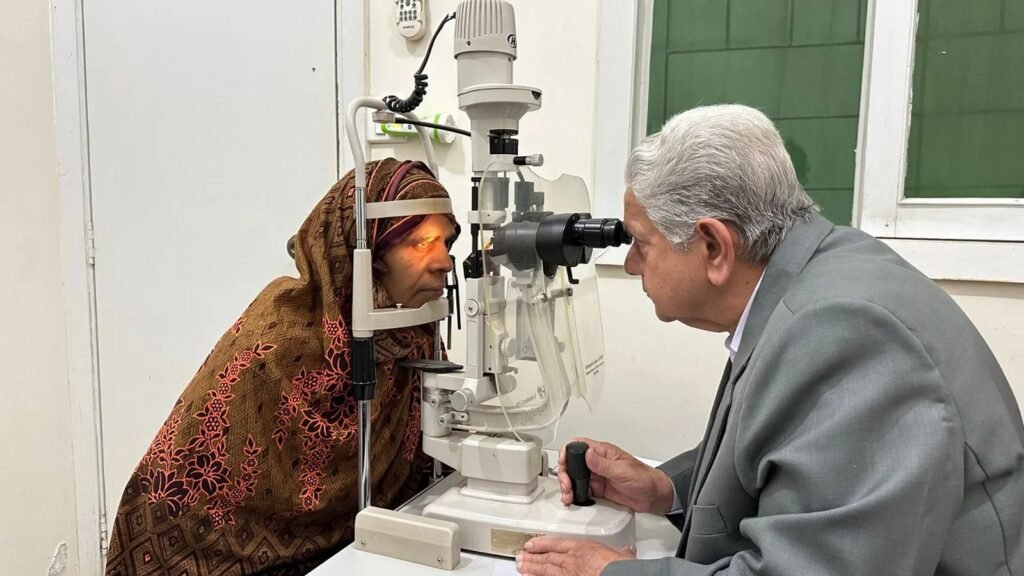
Cataract and glaucoma are spoken about in the same breath in most Karachi households, and they are not the same problem at all. A cataract clouds the lens, and the sight it takes can usually be given back. Glaucoma damages the nerve at the back of the eye, and the sight it takes does not come back. That one difference is why so many people start looking for glaucoma treatment in Karachi only after a father or an aunt has already lost the edges of their vision. This guide explains what glaucoma is, why it is so quiet, who should be checked, and what the first step actually looks like.
The clinical information below comes from the National Eye Institute page on glaucoma, part of the United States National Institutes of Health, read on the day this was written. Nothing here is a diagnosis and nothing here is a prescription. It is background, so that you can have a better conversation with a doctor.
What glaucoma actually is
The National Eye Institute describes glaucoma as a group of eye diseases that can cause vision loss and blindness by damaging a nerve at the back of the eye called the optic nerve. Its symptoms, the Institute says, can start so slowly that you may not notice them, and the only way to find out whether you have glaucoma is to get a comprehensive dilated eye exam.
Two more sentences from that page are worth reading twice. There is no cure for glaucoma. Early treatment can often stop the damage and protect your vision.
Put those together and you have the whole shape of the problem. This is a disease where everything depends on when it is found, and finding it depends on a test rather than on how your eyes feel.
Why you do not feel it coming
At first, the Institute states, glaucoma usually does not have any symptoms, and that is why half of the people who have it do not know they have it. Vision is usually lost slowly, starting with side vision, especially the part of your vision closest to your nose. Because it happens so gradually, many people cannot tell that their vision is changing at all in the early stage.
As the disease gets worse, the Institute says, you may start to notice that you cannot see things off to the side any more. Without treatment, glaucoma can eventually cause blindness.
This is the part that surprises families. There is no pain to warn you in the common form, no red eye, no headache, nothing that feels like an illness. A person can get through a year of ordinary life, work and family functions while the outer edge of their sight is quietly narrowing.
Who should be checked, and how often
Anyone can get glaucoma, but the Institute names some people as being at higher risk. Its list includes being over the age of 60, and having a family history of glaucoma. The list also names particular population groups at younger ages, written for readers in the United States, so for a Karachi reader the useful part is the principle rather than the list itself. Age and family history matter, and a doctor should tell you what they mean in your case.
The Institute’s advice is direct. Talk with your doctor about your risk for glaucoma and ask how often you need to get checked. If you are at higher risk, it says, you need a comprehensive dilated eye exam every one to two years.
If someone in your family has already lost sight to glaucoma, treat that as your reminder rather than as their bad luck. The Institute also advises people who have glaucoma to encourage their family members to get checked, because it can run in families.
The sudden kind, which is an emergency
One form of the disease behaves completely differently. The Institute states that angle closure glaucoma can cause sudden symptoms, and it lists intense eye pain, an upset stomach or nausea, a red eye and blurry vision. Its instruction for those symptoms is to go to your doctor or an emergency room now.
Please take that literally. According to our contact page, PEBS Hospital is open Monday to Saturday, 9:00 AM to 6:00 PM. If sudden eye pain with nausea and blurred vision starts at midnight or on a Sunday, do not wait for the OPD to open and do not wait for us. Go to the nearest hospital that has a working emergency department.
What a glaucoma check involves
The Institute describes the examination plainly. Eye doctors can check for glaucoma as part of a comprehensive dilated eye exam. The doctor puts drops in to widen the pupil and then looks inside the eye, and the exam includes a visual field test to check your side vision. The Institute describes the exam as simple and painless.
On our own side, the published list of diagnostic and clinical services for the Eye Unit at PEBS Hospital includes slit lamp evaluation, auto refraction testing, perimetry, puff tonometry, A and B scans and optical coherence tomography. The Institute’s description of a glaucoma examination includes a visual field test, so it is fair to ask the doctor which of these tests will be used in your case. Which tests any particular patient needs is a decision for the ophthalmologist who examines them, not something to plan from a website.
What treatment can and cannot do
People searching for glaucoma treatment in Karachi usually want the answer to one question. Can it be fixed. The honest answer, in the Institute’s words, is that there is no cure for glaucoma, and that treatment will not undo any damage to your vision but can stop it from getting worse.
The Institute lists the categories doctors use, which are medicines, usually eye drops, laser treatment, and surgery. It says that if you have glaucoma it is important to start treatment right away, to take prescribed medicine every day, to tell your doctor if a treatment causes side effects, and to come for regular check ups.
We are deliberately not going further than that. Which category applies to you, in which eye, at what stage, is a medical decision that belongs to the doctor sitting in front of you with your test results. Do not start, stop or borrow anybody’s eye drops on the strength of an article.
Why people wait, and why waiting costs more with this disease
Three things keep patients away. Money, time off work, and the belief that eyes only need attention when they hurt. The third one is the dangerous one here, for the reason set out above. Sight lost through the optic nerve is not recoverable, so a year of waiting is not a year saved.
On the money side, PEBS Hospital receives no government funding, as our donate page states, and the free and subsidised care given to underprivileged patients is paid for by donors and by Zakat. If cost is the reason a parent has not been examined, ask at the hospital rather than assuming the answer. If you are on the other side of that equation and able to give, the same page is where a donation goes to work.
What to do this week
Whatever brought you to a page about glaucoma treatment in Karachi, the next step is the same. If you are over 60, if glaucoma runs in your family, or if you have not had a proper eye examination in years, book one. Ask the doctor directly whether your optic nerve and your side vision have been checked, and ask when you should come back. Take a list of any medicines you use with you. If you have already been told that you have glaucoma, keep the follow up appointments, because monitoring is the treatment for a disease that gives you no symptoms to judge it by.
You can read more about our units and services on the PEBS Hospital home page, and our address and OPD hours are on the contact page.
Glaucoma is the one eye condition where the patient is usually the last to know, which is why a test beats a symptom every time. One thing to know before you travel. PEBS publishes perimetry and puff tonometry among the Eye Unit’s tests, but it does not publish a glaucoma treatment service, and its published surgical list is cataract surgery, vitreoretinal surgery, corneal transplantation, YAG laser procedures and DCR. So ask on the call whether glaucoma is managed at PEBS or referred onward, before you make the journey. Speak to an eye specialist about your own eyes rather than deciding anything from a screen. To arrange an OPD appointment at PEBS Hospital, call 021-36908053.
Have a question about your eyes?
PEBS Hospital in North Karachi can examine you and explain your options. Call the helpline on 021-36908053, or send a message and the team will reply.
This article is general information and does not replace an examination by an eye doctor.
