Child eyesight problem signs are easy to miss, because a child who cannot see well usually does not know it. She has nothing to compare her vision to. A blurred blackboard is simply what a blackboard looks like. So she squints, edges towards the front row, copies from the desk beside her, or quietly stops trying. At home that often reads as laziness or a lack of interest in school.
This guide is for parents in Karachi who have started to wonder. It sets out what to watch for at home, what the American Academy of Ophthalmology recommends about when a child’s eyes should be checked, and what happens when a child is screened through the PEBS School Eye Clinic.
Signs that mean go the same day
Almost everything in this article is a reason to book a test. A small number of signs are not. If you see any of the following in a child, take her to an eye hospital the same day, and do not wait for an appointment.
- A white or grey reflection in the pupil in a flash photograph, where the other eye shows the usual red glow
- A pupil that looks white, grey or cloudy in ordinary daylight
- An eye that has newly turned inwards or outwards, particularly in a baby or a very young child
- A cornea, meaning the clear front of the eye, that looks cloudy or hazy, or an eye that looks enlarged or bigger than the other one
None of those four is a diagnosis either, and a same day visit that finds nothing wrong is not a wasted trip. They are simply the signs where waiting costs more than going. Outside published hospital hours, take the child to the nearest hospital with an emergency department rather than waiting for the morning.
What to watch for at home
The rest of this list is different. None of the following proves anything on its own, and each one is a reason to book a test rather than a reason to rush. Children are good at hiding a problem they do not know they have, so the pattern matters more than any single habit.
- Sitting very close to the television, the tablet or the book
- Squinting, or half closing one eye, to look at something far away
- Tilting the head to one side when reading or watching
- Rubbing the eyes often, when she is not tired
- Headaches after school, or after homework
- Losing the place while reading, or using a finger to hold the line
- Holding a book unusually close to the face
- Avoiding reading, drawing or close work she used to enjoy
- Watering, redness or crusting that keeps coming back
- One eye that drifts inwards or outwards
- Marks that have slipped for no reason the teacher can explain
That last one is worth pausing on. A child who cannot read the board is missing the lesson rather than failing it. In practice, that is how child eyesight problem signs usually reach a parent, through a report card rather than a complaint.
When a child’s eyes should be checked
Waiting for a symptom is not a plan. The American Academy of Ophthalmology, together with the American Association for Pediatric Ophthalmology and Strabismus, publishes a recommended schedule of vision screenings that begins at birth and continues through the school years.
In outline, a newborn’s eyes should be examined by a doctor or other trained health professional for basic indicators of eye health, including the red reflex and the blink and pupil response. A second screening follows in the first year of life, usually between six and twelve months. Between twelve and thirty six months a child is checked for healthy eye development, sometimes using a photoscreening camera that looks for problems which can lead to amblyopia, or lazy eye. Between three and five years, vision and eye alignment should be checked, and visual acuity tested as soon as the child is old enough to read a chart. From five years, acuity and alignment should be screened again.
The Academy also draws a clear line between a screening and a full examination. A screening is a quick check that sorts children into those who are fine and those who need a closer look. A comprehensive eye examination, with drops used to widen the pupil, is what actually diagnoses disease. The Academy advises parents to seek that fuller examination if a child fails a screening, if the screening was inconclusive or could not be done, if a paediatrician or school nurse has referred the child, or if the child has a vision complaint or a family history of childhood eye problems. The full schedule is set out in the Academy’s guidance on eye screening for children.
What PEBS finds when it screens a school
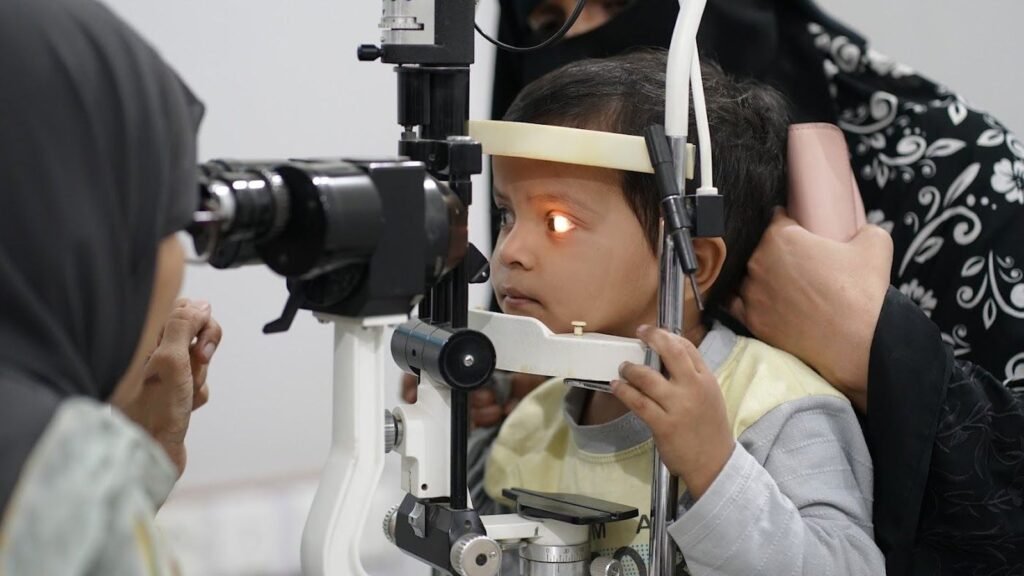
PEBS runs a School Eye Clinic that takes the test to the child rather than waiting for the family to come. The programme page describes four steps. Students are registered and tested for visual acuity on a Snellen chart and for colour vision on an Ishihara chart, in a quiet and comfortable space. A refractionist then runs an objective test on an auto refractor to detect refractive errors. An ophthalmologist performs a slit lamp examination and ophthalmoscopy to identify any ocular disorder. If a problem is found, parents receive a referral to PEBS Hospital for full evaluation and free treatment, which the page describes as glasses, exercises or surgery. If your child is referred and exercises are mentioned, ask the Eye Unit what that covers in her particular case.
The figures PEBS publishes from that programme are worth reading if you are still deciding whether a test is necessary. PEBS states that between May 2025 and June 2026 its teams visited 216 schools and examined 60,159 students, and that refractive errors were found in 14,701 of them, which the page gives as 24.44 per cent of those examined. PEBS also states that 3,337 of the children examined were already using glasses. Within the refractive errors, PEBS reports myopia in 8,574 children, hyperopia in 2,961 and astigmatism in 2,937.
Those are PEBS’s own screening results from Karachi schools, published on its School Eye Clinic page. They are not a national prevalence rate and should not be read as one. But roughly one child in four, in ordinary schools, found by a team that came looking. That is the argument for a test.
Why the teacher often notices first
A parent watches a child in a small room. A teacher watches the same child trying to read something six feet away, alongside thirty others doing exactly the same thing. That difference is the reason PEBS runs a Teacher’s Training Programme beside the school screenings, training teachers to recognise the signs of poor vision in the classroom and refer a student for professional screening. PEBS states that more than 10,680 teachers have been trained. If you teach, or if your child’s school has never had a screening visit, that page explains how a school can ask for one.
What to do next
Book the test. Do not wait for the next report card, and do not guess a prescription. A refraction is a measurement, and it is the measurement that decides whether glasses are needed at all and what strength they should be.
At PEBS Hospital, the Eye Unit lists auto refraction testing, slit lamp evaluation, perimetry, puff tonometry, A and B scans and optical coherence tomography among its diagnostic and clinical services, and names Dr Kashif Farooqui as Head of Department. The hospital publishes its hours as Monday to Saturday, 9:00 AM to 6:00 PM. Bring the school report if grades have slipped, and mention anything from the list above that you have seen at home, even if it felt too small to matter at the time.
You can also reach the team through the contact page if you would rather write than call.
If any of this sounds like your child, book her a test, and speak to an eye specialist about your own eyes at the same visit. Appointments are on 021-36908053.
Have a question about your eyes?
PEBS Hospital in North Karachi can examine you and explain your options. Call the helpline on 021-36908053, or send a message and the team will reply.
This article is general information and does not replace an examination by an eye doctor.