Eye donation in Pakistan raises practical questions about pledging, family wishes and what happens after death. A pledge records a wish; it is not an operation on a living donor. This guide explains the distinction and helps families prepare questions for the organisation they choose. Religious questions deserve a conversation with a trusted scholar, while the receiving team should explain its own clinical and administrative process.
Start with the published pledge process
The society’s instructions for pledging corneas direct people to contact its team to record a pledge and discuss questions. Read those instructions before assuming a process described by another organisation is the same. Ask how your wishes are recorded and what your family should keep.
What eye donation is
It is a pledge. You record, while you are alive and well, that after your death you wish your corneas to be used to give someone else their sight. Nothing is taken from you during your lifetime.
It concerns the cornea, the transparent front part of the eye. LRBT’s explanation of cornea donation describes replacing a damaged cornea with healthy donated tissue through corneal grafting. A patient needs clinical assessment to understand whether a graft is appropriate for their own eye condition.
It is free to pledge. PEBS states plainly that pledging is simple and costs nothing.
Ask the receiving organisation how a pledge differs from an actual donation and which decisions are made later. Recording a wish should not be described as a guarantee about a particular recipient or surgical outcome.
What eye donation is not
It is not something a living person gives up. A pledge takes effect after death. Nobody is asked to part with sight they are still using.
It is not the same as giving money to support a patient’s care. Keep questions about cornea donation separate from questions about funding treatment. Ask the organisation to explain which process is being discussed so a financial contribution is not confused with the donation of tissue.
A pledge should not be treated as a reservation for a relative who needs treatment. If your family has both a potential donor and a patient seeking care, ask separate questions about each situation. Do not infer a priority arrangement or a promise of treatment from a conversation about pledging.
Concerns about the appearance of a loved one after death deserve a direct answer from the receiving team. Ask what the procedure involves and how it is handled respectfully. A family should not feel pressured to accept an answer it does not understand or to hide a question because it seems difficult to discuss.
What happens to a donated cornea
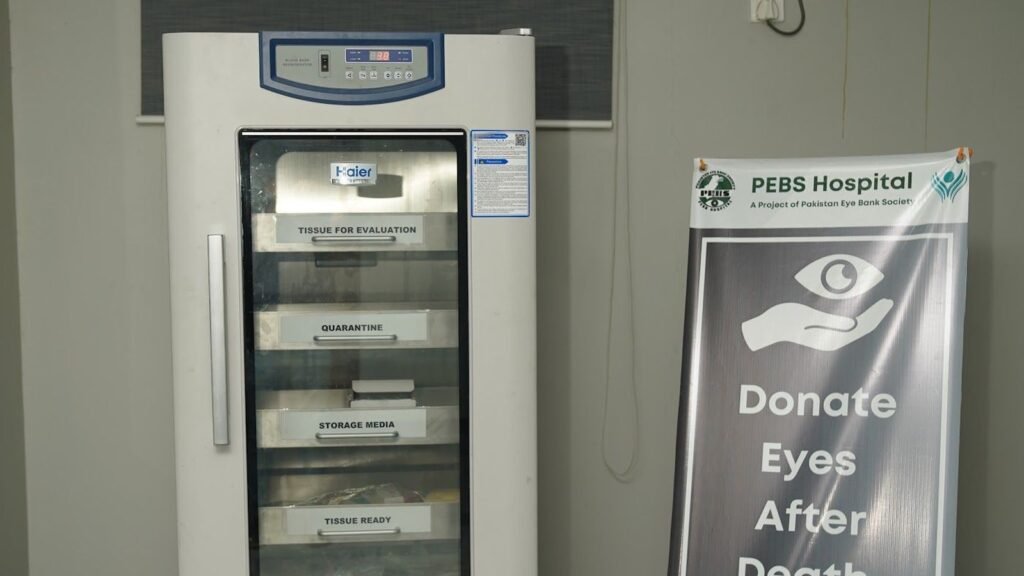
The society’s description of its Eye Bank and Cornea Lab says it receives, evaluates and preserves donated corneas, then supplies them to surgeons for transplantation. That description does not establish the suitability of a particular donation or the expected result for an individual patient.
We are not going to describe the laboratory’s evaluation criteria, its storage method or how long a cornea can be kept. None of that is published, and this is not a subject to fill in from memory. What is published is the shape of it. A cornea arrives, it is assessed and preserved, and it goes to a surgeon and then to a patient.
How PEBS says you pledge
Use the hospital’s official contact route for pledge enquiries. Ask how to record your wishes and how the team answers religious and family questions. Confirm that you have reached the department responsible for the process before sharing personal information.
That is the whole of the published process, so that is the whole of what appears here. There is no online pledge form described on the eye donation page, and this article is not going to invent one, or an age limit, or a medical screening step.
It is worth knowing how another organisation runs it, clearly marked as theirs and not as PEBS’s. LRBT publishes a fuller process on its own page. A pledge form is submitted, the donor is given a card to carry at all times, the donor is asked to tell relatives of the wish to donate, and relatives are asked to inform the hospital within three hours of death so that a medical team can attend. Those are LRBT’s steps, described by LRBT. Do not assume PEBS follows the same sequence. Ask PEBS what its own steps are when you call.
The question about timing and the funeral
If your family is concerned about funeral arrangements, ask the receiving team about the sequence of events. Explain the practical circumstances rather than requesting a general reassurance. A timetable described by another hospital should not be treated as the arrangement that will apply to your family.
What we can say is that timing clearly matters. LRBT asks relatives to make contact within three hours of a death. Put the question to the PEBS team directly on the phone, before you pledge, so that your family hears the answer from the people who would carry it out.
The religious question, briefly
If religious concerns affect the decision, discuss them with a scholar you trust and explain the specific procedure you have been told about. Ask the receiving team for a clear description that can inform that conversation. This article does not issue a religious ruling or claim agreement among all scholars.
Prepare separate questions for the donor and the family
Begin with the person’s own wishes. Ask what they already understand, what remains unclear and whether they want someone to join the conversation with the organisation. A relative can help take notes without deciding on the person’s behalf or presenting an undecided preference as a completed pledge.
Make a short list of questions about recording a pledge. Ask which details the organisation needs, how a record is confirmed and what should be kept with personal papers. If a card or document is issued, ask what it means and whether any further action is needed. Do not assume possession of a card answers every later question.
Then make a separate list for relatives. Ask whom they should contact, what information they should have ready and how the team handles questions outside ordinary office hours. Request the organisation’s own instructions so family members do not have to reconstruct them from memory during a difficult time.
Keep the organisation’s instructions identifiable
Write the organisation’s name and the date beside any instructions you receive. Keep its contact details with them. This helps prevent a form from one charity being mixed with a telephone procedure described by another. If the paperwork and a verbal explanation seem different, ask the organisation to clarify the difference.
Ask which records the organisation expects the family to use. A note about a conversation is not necessarily a completed registration. Equally, an unanswered message is not confirmation that a pledge has been recorded. Find out how the team communicates confirmation and keep that response where the person wants it kept.
If personal details change, ask how the record should be updated. The same applies if the person wants to reconsider their wishes. This article does not invent a withdrawal form or a legal process. The organisation responsible for the record should explain how it handles those requests.
Discuss the plan without forcing agreement
Choose a time when the person and their relatives can ask questions without rushing. Explain which information came from the receiving team and which points still need an answer. Avoid presenting a persuasive story as proof that every practical concern has been settled.
Relatives may have different concerns. One person may want to understand the procedure, while another wants to discuss religion or funeral arrangements. Write down each question in its own terms. Trying to answer all of them with the same reassurance can leave the important uncertainty untouched.
If the person wants help with the discussion, ask the organisation what information it can provide. Share the person’s wishes accurately and respect their choice about who hears personal details. A useful family conversation ends with a clearer understanding, not necessarily an immediate decision.
When a family needs to contact a team after a death
Use the receiving organisation’s current instructions promptly rather than relying on a saved social-media message. Say which organisation recorded the pledge and what information you have. Ask the team to explain the next step directly. Do not assume a message has been received until the responsible service confirms it.
Keep practical questions together so the family can understand the sequence. Ask which staff will communicate with relatives and what information they need. If more than one family member is helping, agree who will keep the written explanation so different versions of the plan are not passed around.
If the team explains that donation cannot proceed, ask for clarification if it is wanted. A pledge expresses a wish; the family should not turn an unsuccessful arrangement into a judgement about the person’s generosity. Questions about the circumstances belong with the organisation handling that particular case.
What to do next
Eye donation in Pakistan does not begin with a form. It begins with a decision and a sentence said out loud. If you want to pledge, phone and say so. If you are not ready, the more useful thing you can do is tell your family what you think, so that nobody has to guess on the hardest day of their lives.
If you are seeking help for your own sight, ask about a clinical appointment rather than a donor pledge. The Pakistan Eye Bank Society’s hospital and eye-care information provides a starting point. An eye specialist can discuss your symptoms and what assessment is appropriate.
Have a question about your eyes?
PEBS Hospital in North Karachi can examine you and explain your options. Call the helpline on 021-36908053, or send a message and the team will reply.
This article is general information and does not replace an examination by an eye doctor.